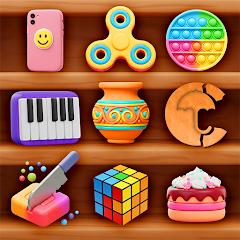
Antistress - relaxation toys
Antistress is one of the most polished fidget-toy collections on Android: over 100 pressure-free toys with convincing physics, satisfying sound and responsive haptics, all working offline. The main caveat is the interstitial ads between toys, which interrupt the calm the app is built for. Regular users will likely want the paid Quiet Pack, and parents may want Google Play purchase authentication switched on.
- Anyone who wants a quick, goal-free way to fidget and decompress for a few minutes between tasks
- Travelers and commuters who need a fully offline distraction for flights and long rides
- ASMR fans who value sound design and tactile haptic feedback more than gameplay
- Tablet owners who want multi-touch toys that respond to several fingers at once
- Players who want levels, scores or progression; there is nothing to chase here
- Anyone bothered by full-screen ads mid-session who doesn't plan to pay to remove them
- Parents handing over a device without Play purchase authentication set up, since the app has no purchase lock of its own
- Owners of older or budget phones, where tilt and touch tracking can feel laggy


Overview
Antistress does what its name promises: you open it, fiddle with something satisfying for a couple of minutes, and close it, ideally a little calmer than before. Its real strength is craft, though it has quantity too: more than 100 tactile toys, with physics, lighting, sound and vibration tuned so that swiping through water or slicing a bar of soap feels convincingly physical. The catch is how it pays for itself. Free users see interstitial ads when they move between toys, and for an app whose whole purpose is an unbroken moment of calm, that interruption is the most important thing to know before installing. If you expect to use it often, budget for the paid Quiet Pack, which removes the ads.
What’s in the toy box
Antistress, from the Italy-based studio JindoBlu, is a sensory sandbox rather than a game in the usual sense. There is no score, no timer, no win or lose state and no leaderboard. You pick a toy from the menu, play with it for as long as you like, then pick another. The library is broad: sliding your fingers through rippling water, pressing buttons, drawing with chalk, cutting soap, and a set of tilt-driven toys such as a Newton’s cradle, marble mazes and liquid pools that respond to the phone’s gyroscope. Tilt or shake the device and the gravity-bound pieces roll, swing and slosh to match.
That breadth matters because stress relief is personal. Some people want something rhythmic and repetitive, some want something to fiddle with mindlessly, and some mostly want a sound. With 100-plus options, you’re likely to settle on two or three favorites and dip into the rest for variety. The app has passed 100 million downloads and holds a 4.7 rating across roughly 878,000 ratings, a strong sign that the core idea works for a very wide audience.
Where the craft shows
What sets Antistress apart in a crowded category of fidget apps is polish. JindoBlu leans on three things, and they reinforce each other.
Physics. Gravity, collisions and fluid movement respond to how you touch or tilt the device: marbles roll and the Newton’s cradle swings as you tip the phone, and water ripples follow your finger. That responsiveness is what makes a virtual fidget feel like more than a picture of one.
Sound. The audio is among the features players praise most often. Each toy uses binaural sound tracks calibrated to match its physics, and with headphones the effect leans firmly into ASMR territory: crisp, close and satisfying. The trade-off is that the soundscape is fixed. You can’t upload your own sounds or swap in a custom track.
Haptics and multi-touch. Vibration responds directly to what you do on screen, and the app supports multi-touch gestures, so you can work several points at once. It is optimized for tablets as well, where the larger screen leaves room to use both hands.
Together, these explain why the app works as a quick reset. The lack of goals is deliberate: there’s nothing to fail at, nothing to optimize, and no reason to feel behind.
The ad question
Here is the plain monetization picture. The base app is free and ad-supported, and the ads that draw the most complaints are full-screen interstitials, video ads included, that appear when you switch from one toy to another. Since trying different toys is the natural way to use the app, a free session can include a fair number of these breaks. Players broadly agree the toys themselves are polished; the friction they describe is an ad arriving just as they had settled into a calm rhythm.
The remedy is the premium Quiet Pack, a purchase that permanently removes third-party ads and unlocks a set of exclusive toys. We’d treat it as close to essential for anyone who opens the app more than occasionally, because the experience Antistress is designed to deliver is an uninterrupted one. Prices vary by region, so check the current figure in the app before deciding. If you only reach for Antistress now and then, the free version is perfectly usable, as long as you expect the breaks.
Where it frustrates
Beyond the ads, the downsides are specific and fairly modest.
- A few toys have awkward controls. The 3D Rubik’s Cube is the clearest example: its drag mechanics make smooth rotation difficult, so a toy meant to soothe can become a small source of frustration. Most of the library avoids this, but the more complex, puzzle-like toys are where it shows.
- Tilt and touch tracking depend on your hardware. On older or budget devices, the gyroscope-driven toys and touch tracking can feel sluggish. Because the tilt toys rely on precise, immediate response, lag undercuts exactly what makes them satisfying.
- Creative toys have a limited palette. The drawing, chalk and modeling activities offer only a small set of colors. That’s fine for doodling, but anyone hoping for a coloring or art-therapy tool will find it restrictive.
- No custom audio. The sound design is excellent but fixed.
None of these is a dealbreaker on its own, but if your phone is several years old or you mainly want a creative outlet, they carry more weight.
A note for parents
The toys themselves are gentle and non-competitive, so the app may well end up in younger hands. Two practical points are worth knowing. First, the app has no parental gate of its own in front of in-app purchases, and the Quiet Pack button sits directly on the main interface, where a curious child can reach it easily. Turning on purchase authentication in Google Play’s own settings is the sensible safeguard. Second, the free version shows third-party ads between toys, and the Quiet Pack removes them entirely.
What players keep saying
Three themes come up again and again. The first is sound and motion: players describe the fluid movement and high-fidelity effects as genuinely immersive, and that is the most common reason people keep the app installed. The second is the ads, specifically the full-screen video ads between activities, which many feel work against the calm the app sets up. The third is travel. Because Antistress runs fully offline and has no timers, people use it to decompress on flights, train rides and long car journeys where a connection is patchy or missing.
How it compares
Against other fidget and antistress apps, of which there are many, Antistress’s reputation rests on production quality. Plenty of competitors offer a similar menu of toys; fewer back them with physics, binaural audio and haptics at this level. Many of those alternatives are ad-supported too, so switching apps rarely sidesteps the ad question.
Against guided meditation apps such as Calm or Headspace, it’s a different kind of tool. Those offer structured breathing, sleep content and courses, usually behind a subscription. Antistress offers no guidance at all; it’s a distraction rather than a practice. For a two-minute break from a stressful task it’s quicker to reach for, but for building a lasting calming habit, a guided app does more.
Against physical fidget toys, the trade is variety and sound versus simplicity. A physical toy has no ads, no screen and no battery to drain, and some people find it more grounding. Antistress puts a hundred toys in your pocket, but on a screen.
A note on recency
The Play listing was last updated on September 10, 2026, and the developer says new toys arrive about every two weeks. That cadence, along with the size of the current library, points to an actively maintained app rather than one relying on its existing catalog.
Who it’s not for
Antistress isn’t for anyone who wants a goal. If you enjoy levels, scores or a sense of progression, the open-ended design will feel aimless. It’s a weaker fit for people who find full-screen ads disruptive and don’t want to pay to remove them, because the breaks land right where the calm should be. Owners of older phones may find the tilt toys laggy enough to blunt the appeal. And if you’re after a creative or art tool, the limited color options will hold you back.
The verdict
Antistress is one of the most polished relaxation toy boxes on Android, and its reputation is well earned: convincing physics, standout sound design, responsive haptics and a pressure-free structure that works offline. The ads between toys are its one significant drawback, and they matter more here than in most free apps because they interrupt the very feeling the app exists to create. Start with the free version to find the toys you like; if you end up opening it daily, the Quiet Pack is worth buying for the uninterrupted experience. Parents should switch on purchase protection first.
How We Evaluate
This review draws on Antistress's Google Play listing and description, its in-app purchase and permission details, its 4.7 rating across more than 877,000 ratings and 100M+ downloads, its most recent update, and recurring themes in player reviews and community discussions. We also weigh the app's long-standing public reputation in the fidget and relaxation category. The Quiet Pack's price and the exact frequency of ads can vary by region and over time, so both are worth checking in the app.
Pros & Cons
Massive Library of Sensory Toys: Offers over 100 different interactive activities, catering to varied relaxation preferences.
Realistic Physics Simulations: Delivers realistic gravity, collision, and fluid dynamics across all interactive elements.
Responsive Haptic Feedback: Integrates precise device vibrations that respond directly to screen interactions.
Relaxing Sound Profiles: Features high-quality binaural sound effects that provide satisfying ASMR audio cues.
Pressure-Free Sandbox Design: Contains no high scores, timers, or competitive leaderboards, keeping the experience stress-free.
Excellent Offline Support: Runs completely offline, making it a highly accessible tool for quick relaxation during travel.
- ✕
Frequent Interstitial Ads: Ads appear when switching between different toys, interrupting the relaxing sensory experience.
- ✕
Unintuitive Controls on Select Puzzles: Specific toys like the Rubik's Cube feature clunky drag mechanics that can feel frustrating.
- ✕
Variable Gyroscope Performance: Device tilt-tracking can feel slightly sluggish or laggy on older or budget hardware.
- ✕
Limited Color Options: Drawing, chalk, and modeling activities offer a limited color palette, reducing creative freedom.
Download


FAQs
Does the application support custom user-uploaded ASMR sounds?
No. The application relies on its built-in, highly optimized binaural audio tracks, which are specifically calibrated to match each individual toy's physics.
What is unlocked when purchasing the premium "Quiet Pack"?
The premium "Quiet Pack" permanently removes all third-party advertisements and unlocks exclusive sensory toys.
Why does the app require gyroscope permissions?
Many interactive toys (such as the Newton's cradle, liquid pools, and marble mazes) use the device's internal gyroscope to calculate movement based on physical tilt.
Is there a child-safe lock on the in-app purchase options?
No. The "Quiet Pack" purchase button is directly accessible from the main interface, so parental supervision is recommended for younger children.
Can I run this relaxation app on tablets with multi-finger touch?
Yes. The app is fully optimized for tablet screens and supports multi-touch inputs, allowing users to interact with multiple sensory points at once.
Hot Reviews
Summarized from Google Play reviews and community discussions.
The fluid movement and high-fidelity sound effects provide an immersive and highly satisfying sensory experience.
While the interactive toys are highly polished, the full-screen video ads that play when switching activities disrupt the calming atmosphere.
The full offline functionality and lack of competitive timers make it an excellent tool for quick decompression on long rides.