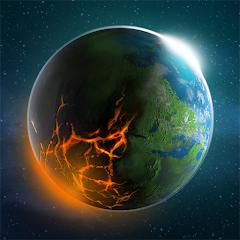
TerraGenesis - Space Settlers


Overview
Created by Alexander Winn and published in partnership with Tilting Point and Edgeworks Entertainment, TerraGenesis - Space Settlers is a scientifically grounded space colonization and planetary terraforming simulator. Departing from arcade-style space strategy games, TerraGenesis anchors its gameplay loop in planetary datasets from NASA, thermodynamic physics, and real-world environmental science. The software challenges players to transform hostile, barren planetary bodies into self-sustaining biospheres capable of supporting human civilization.
The operational scope of TerraGenesis encompasses authentic planets within the Solar System (including Mars, Venus, Mercury, and Earth), major planetary moons (such as Europa, Titan, and Ganymede), dwarf worlds (like Ceres and Pluto), and procedurally generated exoplanets. Players manage five interdependent global atmospheric metrics: Surface Temperature, Atmospheric Pressure, Oxygen Concentration, Water/Sea Level, and Biomass. Modifying these metrics requires constructing industrial surface facilities, deploying orbital satellites, establishing outposts, and managing delicate ecological feedback loops. The simulation accurately models fluid dynamics; for example, elevating global surface temperature melts polar ice caps, raising sea levels and dynamically flooding low-altitude topography based on authentic NASA elevation maps.
In addition to inorganic atmospheric modification, TerraGenesis includes a comprehensive genetic engineering biosphere simulator. Players can splice specific genes to create custom plant, herbivore, and carnivore species, balancing complex food webs to prevent ecological collapse. Concurrently, players direct the societal and ideological evolution of their colony, choosing core principles (such as Democracy, Authority, or Ecological Preservation) and responding to random cultural events. The engine operates on a real-time idle framework, meaning planetary environmental shifts occur continuously over actual hours and days. This design delivers a deliberate pacing structure, supported by a meditative musical score and a clean UI. The monetization model remains fair; premium currency (Genesis Credits) can be earned organically through gameplay milestones and voluntary ad views, though accessing certain distant moon systems requires purchasing expansion packs.
Pros & Cons
Scientifically accurate simulation framework utilizing NASA topographic and atmospheric datasets.
Interdependent environmental physics where thermodynamic changes directly alter surface water levels and terrain.
Deep biosphere generator allowing players to genetically engineer custom organisms and build stable ecosystems.
Soothing, ambient soundtrack paired with a clean visual UI designed for thoughtful strategic planning.
Fair monetization model allowing premium currency to be earned through gameplay and voluntary ad participation.
- ✕
Steep learning curve that can overwhelm casual players unfamiliar with multi-variable environmental balancing.
- ✕
Real-time progression speed means major planetary transformations require days or weeks of passive time.
- ✕
Unlocking full campaigns for outer moon systems requires purchasing world expansion content.
Download


FAQs
Is TerraGenesis based on genuine planetary science?
Yes, the application utilizes real NASA scientific data for planetary surface topographies, starting atmospheric values, gravitational constants, and thermodynamic calculations.
What happens if environmental parameters are left unmonitored?
Because environmental systems operate continuously in real-time, unmonitored industrial structures can cause catastrophic runaway effects, such as completely evaporating surface oceans or flooding inhabited coastal colonies.
How does the planetary defense network function?
Players can construct orbital defense arrays to detect rogue asteroids trajectory-bound for their planet. Players can initiate space missions to destroy the threat, alter its trajectory, or harvest it for resources.
Can TerraGenesis be played offline?
Yes, the offline simulation engine continues calculating environmental statistics and colony resource production while the app is closed.
Hot Reviews
Players frequently commend the game's scientific fidelity, noting that balancing real atmospheric stats like oxygen concentration, air pressure, and surface temperature provides an intellectually stimulating experience.
Reviewers praise the peaceful musical score and minimalist aesthetic. Furthermore, users appreciate that premium currency can be obtained without mandatory payment, keeping progression accessible.
Some players express minor frustration with the slow real-time transformation speeds, pointing out that shifting an entire planet's atmosphere requires significant real-world waiting time.