Daily Mahjong Match
Daily Mahjong Match treats legibility as a headline feature rather than an accessibility checkbox — large high-contrast tiles, an auto-zoom that removes the squint, and boards the developer states are always solvable. Two things to set expectations before installing: this is single-player Mahjong solitaire rather than the four-player game, and the 'Cognitive Longevity' brain-training framing is Big Cake's positioning, not a verified health benefit.
- Anyone who wants a calm, fully offline tile-matching puzzle for a quiet half hour — especially players who find most mobile games' small targets and busy screens hard to read, since the large high-contrast tiles and auto-zoom are the genuine standout here
- Mahjong solitaire regulars who have been burned by boards that dead-end, and players who enjoy chasing combo chains for a little extra skill depth on top of a relaxed loop
- Anyone looking for traditional four-player Mahjong with hands, scoring, and social play — this is the solitaire variant, as the app's own FAQ states
- Players who want a game with no video ads out of the box, or who need constant mechanical novelty rather than the same matching loop across many levels
- Anyone shopping for a validated cognitive-health product — the brain-training language is the developer's positioning, and we are not in a position to verify cognitive benefits
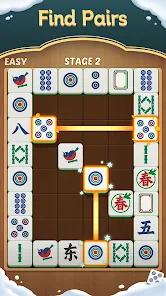
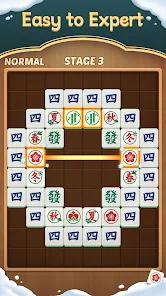



Overview
Most mobile puzzle games ask you to squint. Daily Mahjong Match starts from the opposite assumption — that a tile you can comfortably see beats a tile that photographs well — and that decision carries the app. Big Cake built a Mahjong solitaire game around large, high-contrast tiles and an auto-zoom that snaps to whatever part of the board you touch, and the reception is unusually warm: 10 million-plus installs and a 4.9 average across 165,148 ratings. Our job is to separate what we can stand behind from the developer’s own framing — and one piece of it, around brain training, needs careful reading.
What it actually is — and what it isn’t
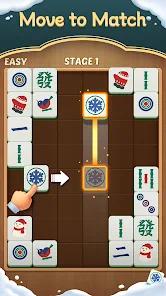
The most useful thing we can say is what the FAQ leads with: this is not the four-player Mahjong game. Traditional Mahjong is a four-player game with hands and scoring. What you get here is Mahjong solitaire — a single-player puzzle where tiles sit in a stacked layout and you clear the board by matching free pairs until nothing is left. Credit to Big Cake for putting that answer first in the FAQ rather than burying it. The app is categorized as Offline, and our database records that 100% of core gameplay works without a connection.
The large-tile design is the real headline
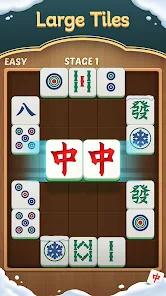
If one thing here beats the field, it is legibility. Tiles are large and high-contrast by default, and the art can be swapped — the FAQ lists traditional, modern, and high-contrast sets among the unlockable styles, so contrast is a customization axis, not a buried toggle. Paired with it is the auto-zoom: tap near a tile and the view focuses on that region, so a dense stack becomes targets you can hit first time.
That combination is the most consistent theme in published feedback: one reviewer who says they have tried every Mahjong app rates these tiles the easiest to see, and another describes the auto-zoom as the thing that stopped them squinting at their phone. It is the kind of decision that is easy to skip and hard to retrofit, and in our view the single strongest reason to pick this app over another.
”Match-Back” and the dead-end problem
The second decision worth knowing is how boards are made. Every layout is procedurally generated, and Big Cake says a proprietary system it calls “Match-Back” guarantees each one is solvable. That is the developer’s stated design, not something we verified — an algorithm like this cannot be audited from the outside.
It is worth flagging, because the failure mode it names is a familiar risk in tile-matching puzzles: a stacked layout can leave pairs that never come free, so a run ends not because you played badly but because the deal could not be finished — and you cannot tell which happened. Big Cake’s description attributes that to lower-quality Mahjong apps; we would put it more neutrally, as a hazard of procedural generation the guarantee is meant to remove. The FAQ also describes hints and a Shuffle option for players who stall, and one reviewer, a daily player, describes the levels as challenging but never impossible.
Combos, and the skill ceiling under the calm
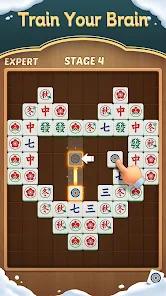
Filing this as a game with no depth would be a mistake. Big Cake highlights what it calls “Combo Mastery” — matching pairs in rapid succession is worth more than matching them one at a time — and that changes how an experienced player reads a board. Rather than clearing whichever pair you spot first, you scan for chains: which matches fire back-to-back, and what that exposes underneath. Nothing forces you to play fast; a player who ignores combos can still finish. But it gives the game a second gear.
World Journey and the postcards
The progression layer is the answer to “why keep playing.” Levels are themed around cultural motifs and seasons, and the mode that comes up by name in published feedback is World Journey, built around collectible postcards from different countries. Our database describes that system as educational — the cards carry facts about world cultures — and the reviewer who raises it calls collecting them a lovely touch; separate feedback singles out the calm music and the tile-click sounds. It is a modest but well-judged hook. The listing is inconsistent on level count — the description says “thousands,” the FAQ says over 1,000 with new ones monthly through 2026 — so we will not put a precise number on it.
About the brain-training claim
Here is the part of the listing to read carefully. Big Cake positions the 2026 version around what it calls “Cognitive Longevity,” presenting the app as a brain-training tool as much as a game; the FAQ says the game is designed to improve pattern recognition, focus, and short-term memory.
That is the developer’s positioning, and we attribute it rather than endorse it. We cannot verify cognitive benefits: the listing offers no clinical evidence, we ran no testing of our own, and whether puzzle games transfer to real-world cognitive function is not something an app review can settle. Nothing here should be read as the app preventing, delaying, or treating cognitive decline, memory loss, or any other condition. It is not a medical or preventive-health product, we make no health claim for it in either direction, and nothing in this review is health advice.
The fair version is simpler: this is a pleasant, low-stress puzzle that a lot of people play daily and enjoy. Play it for that, read the brain-training language as marketing positioning, and it is easy to like.
The ads and the in-game currency, plainly
Monetization is straightforward, and the FAQ states it: the entire game can be played free, supported by ads. The free version serves periodic video ads that can be skipped only after a delay — the forced-view pattern rather than an instant close. We are not putting numbers on that — the material gives none, and we have not measured it ourselves.
The second cost is softer. Our database flags that some advanced power-ups are expensive in in-game currency, so the shortcuts out of a tight board are rationed unless you grind — a minor tax for most players, real friction for anyone who leans on them. Our material does not say whether a paid ad-removal option exists, so check the store listing.
How it compares
We have not benchmarked this against named rivals, so treat this as framing, not a head-to-head. The two things that would make us reach for it over another Mahjong solitaire app are the ones above: legibility treated as a design goal rather than a settings toggle, and a stated guarantee that no board can dead-end. One of those you can check for yourself in a minute; the other you take on the developer’s word. The third difference is tonal — Big Cake’s own description reaches for the word meditative, and the store material foregrounds calm and cultural theming over competition.
A note on recency
The listing shows a Play update dated March 16, 2026, and the FAQ promises new levels monthly through 2026 — signs of active work, not drift. A 4.9 average across 165,148 ratings is a high bar to hold, and the praise behind it is specific — legibility, calm, the postcards — rather than vague.
Who it’s not for
Three groups should look elsewhere. Anyone wanting traditional four-player Mahjong will not find it here. Anyone who wants zero ads should know the free version’s video ads are the arrangement, and we cannot promise a purchase removes them. And anyone shopping for a validated cognitive-health product should not read the brain-training framing as evidence of one.
There is a softer fourth: players who need constant mechanical novelty. Tile matching is the whole game, level after level, and our database’s own cons note that later levels can feel repetitive. If a puzzle has to keep surprising you, this one likely will not.
Our take
Daily Mahjong Match earns its 4.9 the honest way — by being easy to see, easy to pick up, and hard to get stuck in. The large high-contrast tiles and the auto-zoom are the standout, and a real improvement for anyone who has quietly given up on games with small, fiddly targets. Match-Back is Big Cake’s stated design rather than a verified one, but it targets a failure worth designing out; the combo mechanic adds more depth than the surface suggests; the World Journey postcards give a session somewhere to go.
Two caveats. The periodic video ads and the in-game-currency cost of advanced power-ups are the price of a free game, worth knowing before you install. And the “Cognitive Longevity” framing is the developer’s positioning, which we attribute rather than verify — the right reason to play is that it is a pleasant way to spend a quiet half hour. On that basis, an easy recommendation.
How We Evaluate
We did not hands-on test this game. This review is a desk assessment grounded in Daily Mahjong Match's Google Play listing and description, its stated features (Mahjong solitaire layouts, the large-tile UI, auto-zoom, the "Match-Back" board generation, combo scoring, the World Journey postcard theming, hints and Shuffle, tile customization, and offline play), the pros and cons in our app database, its FAQ, recurring themes across published user reviews, and its store signals — a 4.9 aggregate from roughly 165,148 ratings alongside 10M+ installs, the store screenshots, a Play update dated March 16 2026, and developer Big Cake. Two items we attribute rather than assert: the proprietary "Match-Back" algorithm that Big Cake says guarantees every procedurally generated board is solvable, and the "Cognitive Longevity" brain-training positioning. We have no way to audit a board-generation algorithm from the outside, and we are not in a position to verify cognitive benefits — the app is not presented here as a medical or preventive-health product. Where we cite user sentiment, we are reflecting documented recurring feedback in the store material rather than play sessions of our own.
Pros & Cons
Senior-friendly interface with large, clear, high-contrast tiles.
Guaranteed solvability on every procedurally generated board.
Thousands of levels with culturally diverse themes and designs.
Offline play support for 100% of core gameplay.
Satisfying 'Combo' mechanics for advanced players.
Educational 'Postcard' system that shares facts about world cultures.
- ✕
Later levels can feel repetitive due to the nature of the game.
- ✕
The free version features periodic video ads that can be skipped only after a delay.
- ✕
Some advanced power-ups are expensive in terms of in-game currency.
Download


FAQs
Is this the same as the 4-player game?
No, this is Mahjong Solitaire, which is a tile-matching puzzle for one player.
What happens if I get stuck?
The app offers hints and a 'Shuffle' feature to help you find a new path forward.
Can I customize the tiles?
Yes, you can unlock many different tile styles, including traditional, modern, and high-contrast.
Is the game free to play?
Yes, the entire game can be played for free, supported by ads.
How many levels are there?
There are currently over 1,000 levels, with new ones added every month in 2026.
Does the app help with brain training?
Yes, the game is designed to improve pattern recognition, focus, and short-term memory.
Hot Reviews
I've tried them all, but this one has the best graphics and the tiles are the easiest to see.
The music and the sound of the tiles clicking are so calming. It's the perfect way to spend a quiet hour.
I'm 75 and I play every day to keep my brain sharp. The levels are challenging but never impossible.
I love the 'World Journey' mode. Collecting the postcards from different countries is a lovely touch.
The auto-zoom feature is a lifesaver. I don't have to squint to see the tiles on my phone anymore.