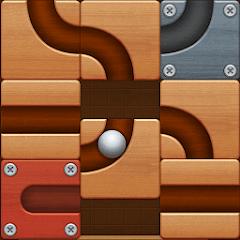
Roll the Ball® - slide puzzle
The sliding-tile puzzle underneath is well-built and genuinely deep, and the untimed, offline-capable modes are a real part of the appeal. What to weigh first is the delivery layer around it: our records document unskippable 30-to-45-second interstitials after nearly every level, and an 'Ad-Free' purchase our source says also removes the opt-in videos free players use to earn hints.
- Players who want a route-building logic puzzle — our records describe swiping dynamic wood tiles around fixed metallic blocks to assemble one unbroken path for a steel ball
- Anyone who plays to decompress: our database lists 'no involuntary timers' as a strength, because the standard modes let you solve at your own pace, with the countdown timer confined to its own mode
- Players who need a puzzle that works without a connection — our records state the core puzzle levels run entirely offline, and a recurring theme in our stored user feedback praises exactly that on long commutes
- Optimizers: our source material and the listing FAQ both record that three stars requires the most efficient route through all three star tiles, not merely a completed path
- Players who want the puzzle to be doing something — our database credits the app with exercising visual memory, spatial logic and hand-eye coordination
- Anyone with a low tolerance for interstitial advertising — our database's cons record unskippable ads of roughly 30 to 45 seconds after nearly every level, which our records note can exceed the time spent solving the puzzle
- Players who expect a paid upgrade to be a clean fix — our source material and the listing FAQ both state the 'Ad-Free' purchase removes the opt-in videos that earn free hints, leaving hints purchasable with real money
- Anyone who wants the level count confirmed before committing: our own material carries two figures we cannot reconcile (over 3,000 levels versus five tiers of 60)
- Long-haul players who need the puzzle vocabulary itself to keep evolving — our database's cons note the immovable metallic blocks can lead to repetitive designs in the higher tiers


Overview
Roll the Ball is a case where the puzzle design is the strongest thing in the package and the monetization is the thing you notice first. Our source material describes the core as a classic entry in the gridlock slide-puzzle genre: a grid of movable wood tiles, immovable metallic blocks and pathways, and a steel ball that rolls the moment you assemble an unbroken route from the start block to the goal. Our records put it at 100M+ downloads, and the friction they document most heavily sits in the monetization layer rather than in the puzzle.
The puzzle underneath
Our records are specific about the two tile types, and the distinction is the whole game. Wood tiles are dynamic — the listing FAQ says they can be freely slid into adjacent open spaces to form paths. Metallic blocks are locked in place, serving as fixed spatial obstacles. Our source material describes the goal as one unbroken path assembled by swiping those wood tiles into empty grid spaces; the immovable blocks are what stop that being a drawing exercise, and “gridlock” is our source’s own word for the genre.
The completion condition is clean: once a viable path exists, the ball rolls. Our source describes the movement as physics-based, and our database’s pros credit smooth slide animations and realistic rolling physics as the ball traverses the finished path — in a puzzle whose reward for correct reasoning is watching the route resolve, that presentation is doing real work. Our database also files cognitive skill development as a strength, crediting the game with exercising visual memory, spatial logic and hand-eye coordination.
Where the difficulty actually lives
Completing a level and completing it well are separate problems here. Our source material records that stars sit on specific tiles scattered across the board and that a perfect three-star rating requires the most efficient path; the listing FAQ agrees, putting ratings on routing efficiency and three stars on a path that runs directly through all three star icons. The minimum bar is any connected route; the real bar is the route that also threads every star.
That is what our stored user feedback singles out as the reason to replay: one recurring theme calls the star-collection system highly rewarding, with the hunt for the most efficient three-star route keeping early levels worth returning to.
Four modes, four jobs
Our source material lists four. Classic Mode is untimed — you solve at your own pace and optimize for the fewest moves. Star Mode is the primary progression mode, built around planning a path that collects the three positioned stars. Countdown/Timer Mode adds a strict timer that releases the ball automatically at zero, which our source says demands rapid visual calculation and quick reflexes. Multiplayer is real-time competitive matchmaking, and the FAQ confirms a dedicated matchmaker where players go head-to-head on the same grid.
The variety is filed as a strength in our database, and one point inside it matters: our records list no involuntary timers as a pro, because the standard modes let players work at their own pace. The timer is a mode you choose, not pressure applied to everything.
Offline play is the other structural strength recorded. Our database states the core puzzle levels run entirely offline, requiring no internet connectivity, and a recurring theme in our stored feedback frames that as the commute case — reliable on a long journey, without draining cellular data. The recorded scope is the core levels; our material does not extend it to the multiplayer matchmaker.
The advertising, by our records’ numbers
Our database’s cons state that unskippable interstitials of roughly 30 to 45 seconds appear after nearly every level, and add the comparison that gives it weight: that can easily exceed the time spent solving the puzzle itself. Every element of that is our records’ wording — the length, the “unskippable”, the cadence and the comparison to solving time. We measured no ad frequency ourselves. It is also the note our stored feedback leads with: one theme praises the smooth slide mechanics and the cognitive challenge in the same breath as calling the volume of post-level ads frustrating.
The second ad type is opt-in: our source material records that under the standard free-to-play structure, players watch voluntary video ads to unlock hints when stuck. On its own terms that is a fair trade — the hint costs attention rather than money.
Separately, our database’s cons record regular prompts to buy extra coins, hint bundles or premium upgrades. Our material carries no prices, so we cannot say what any of it costs.
The “Ad-Free” purchase and the hint problem
The most unusual item in our records is what happens when you pay. Our source material states that purchasing the premium “Ad-Free” version disables all opt-in video integrations without providing an alternate path to earn hints, and that premium players must therefore spend additional money on coin packs to buy hints.
The listing FAQ covers the same ground more narrowly, and the difference is worth stating. It says only that the ad-removal upgrade does not grant free hints, that it prevents players from watching ads to earn them, and that hints must be purchased with real money instead. It does not mention coin packs, does not put the scope at “all opt-in video integrations”, and does not carry the characterization our own description field adds.
That characterization is the sharpest language in our material, and it belongs to our source rather than to us: our source material calls the arrangement a frustrating paradox that effectively punishes players for purchasing the ad-free upgrade, and our database’s cons file it as flawed premium monetization that forces premium players to buy hint coins with real money. We reproduce that wording as our source’s and do not adopt it as our own conclusion. A recurring theme in our stored user feedback covers the same complaint — users frustrated that removing ads locked them out of the free hint system. The mechanic, not the framing, is the part a buyer needs.
How much game is here
Our records disagree with themselves on volume. Both our source material and our database’s pros state over 3,000 structured levels across several difficulty tiers. The listing FAQ describes progression as five categories — Beginner, Intermediate, Hard, Advanced and Extreme — with each tier offering 60 unique puzzles, which totals 300. That is a gap of roughly ten to one inside our own material. Nothing in our records reconciles it, and we are not going to resolve it by picking the more flattering figure; anyone for whom catalogue size decides the install should know both numbers exist.
Where the design thins out
One recorded limitation belongs to the mechanic itself: our database’s cons note that because the metallic blocks cannot be moved, higher-level tiers can tend toward repetitive puzzle designs. It is the criticism most likely to matter to someone playing for months rather than weeks.
Reception and recency
A 4.1 average across 1,392,733 ratings is an unusually large sample, and our records show the Play listing updated on April 9, 2026. Our stored feedback splits along the same seam our database does: the slide mechanics, the star chase and the offline reliability draw the praise; the ad volume and the ad-free hint situation draw the complaints. Our records file six strengths against four weaknesses — the strengths mostly about the puzzle and how it runs, three of the four weaknesses about money and attention.
Who it’s not for
Anyone with a low tolerance for interstitial advertising — the recorded cadence above is what most shapes how this plays day to day. Anyone expecting a paid upgrade to be a clean fix, since our records are explicit that the “Ad-Free” purchase removes the free-hint route along with the ads. Anyone who wants the catalogue size confirmed first, given the unreconciled figures. And anyone who needs the puzzle vocabulary to keep evolving, given the recorded tendency toward repetition in the higher tiers.
Our take
Roll the Ball’s core is genuinely good, and our records support that read: a clean sliding-block route-builder with an efficiency layer on top, four modes that do different jobs, no forced timers in the standard ones, a catalogue that runs offline, and animation quality filed as a strength.
We land at 3.9, a little under the 4.1 store average. The strengths our records list are load-bearing and we have not discounted them; what takes the edge off is that the two most consequential recorded cons — the interstitial cadence and the behaviour of the ad-removal purchase — are each corroborated by our stored user feedback rather than resting on a single line in our database.
We file it as situational because those two are worth deciding about before installing rather than after. If interstitials of that length between levels are tolerable, our records describe a great deal of puzzle here at no cost. If they are not, our material records that the paid route out also removes the free-hint mechanism, and that is the trade to weigh.
How We Evaluate
We did not hands-on test this game. We did not install it, solve a level, watch or time an ad, buy the ad-removal upgrade or enter a multiplayer match. This is a desk assessment, and it rests on our own editorial database entry for Roll the Ball - slide puzzle: the mechanics recorded there (dynamic wood tiles, static metallic blocks, the steel ball and the path it needs, the star-efficiency rating, and the Classic, Star, Countdown/Timer and Multiplayer modes), the pros and cons filed alongside it, the listing FAQ, and the recurring themes across published user feedback — which we read as sentiment summaries written up by our team rather than verbatim quotes, and to which we attach no individual star ratings. We also weighed the store signals: a 4.1 average from 1,392,733 ratings, 100M+ downloads, nine screenshots, a Play listing updated April 9 2026, and developer BitMango. Three limits on what follows. First, we describe board layouts, level structure and assist systems only where our source states them, and leave anything unstated rather than assuming a genre default. Second, where our material records a monetization criticism, we report it at the scope it is written, attributed to the source, and add nothing to it. Third, where two parts of our material disagree, we say so instead of picking the more flattering number.
Pros & Cons
Exceptional Content Volume: Provides over 3,000 levels, offering a long-lasting puzzle experience across several difficulty tiers.
Engaging Variety of Modes: Includes classic, star, countdown, and multiplayer modes to suit different playstyles.
No Involuntary Timers: Standard modes allow players to solve puzzles at their own pace, making for a relaxing experience.
Solid Visual Feedback: Features smooth slide animations and realistic rolling physics as the ball traverses completed paths.
Effective Offline Play: The core puzzle levels run entirely offline, requiring no internet connectivity.
Cognitive Skill Development: Successfully exercises visual memory, spatial logic, and hand-eye coordination.
- ✕
High Ad Interstitial Frequency: Prompts unskippable 30-to-45-second ads after nearly every level, which can easily exceed the time spent solving the puzzle itself.
- ✕
Flawed Premium Monetization: Disables the ability to watch ads for free hints after purchasing the "Ad-Free" version, forcing premium players to buy hint coins with real money.
- ✕
Static Obstacles at Scale: Metallic blocks cannot be moved, which can lead to repetitive puzzle designs in higher-level tiers.
- ✕
Aggressive Up-selling Prompts: Regularly nudges players to buy extra coins, hint bundles, or premium upgrades.
Download


FAQs
What is the difference between dynamic wood tiles and static metallic tiles?
Wood tiles can be freely slid into adjacent open spaces to form paths. Metallic blocks are locked in place and cannot be moved, serving as fixed spatial obstacles.
How are star ratings calculated for completed levels?
Ratings depend on routing efficiency. To secure a perfect three-star rating, players must align the tiles to create a path that runs directly through all three star icons on the grid.
Does purchasing the "Ad-Free" version unlock unlimited hints?
No, purchasing the ad-removal upgrade does not grant free hints. In fact, it prevents players from watching ads to earn free hints, requiring them to purchase hints with real money instead.
Is there a real-time multiplayer option?
Yes, the game features a dedicated multiplayer matchmaker where players compete head-to-head to solve the same grid puzzle as quickly as possible.
What are the difficulty tiers present within the level index?
Progression features five main categories: Beginner, Intermediate, Hard, Advanced, and Extreme, with each tier offering 60 unique puzzles.
Hot Reviews
Players appreciate the smooth slide mechanics and cognitive challenges, but note that the sheer volume of post-level ads makes the game frustrating to play.
Several users express frustration with the ad-free upgrade, explaining that removing ads locks them out of the free hint system and requires them to pay real money for gameplay assists.
Reviews highlight the classic star-collection system as highly rewarding, noting that finding the absolute most efficient path to secure three stars keeps early levels highly replayable.
Players praise the game's reliable offline performance, noting that it serves as an excellent time-killer during long commutes without draining cellular data.