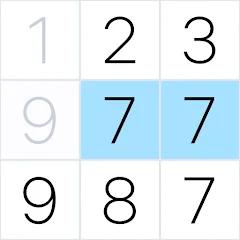
Number Match - Number Games
Easybrain's take on the classic ten-matching number game is polished where it counts — untimed, fully playable offline, with a generous undo and a genuinely clever rule that lets a pair connect across a line break. The frictions worth weighing are the ones every player meets: a high-contrast white interface our records say has no in-app dark alternative, and a change that left haptic feedback firing only on matches.
- Players who want a puzzle with no clock running — our records describe a relaxed, untimed environment where you can work a board through at your own pace
- Anyone who needs a game that works with no signal: our FAQ records it as fully playable offline, and the store places it in the Offline category
- People who enjoy reading a board rather than reacting to one — pairs connect across horizontal, vertical and diagonal neighbours, and a pair may run from the end of one line to the beginning of the next, which our records say adds a layer of spatial scanning
- Players who want structure around a simple loop: our records describe competitive tournaments, daily challenges carrying unique monthly trophies, and themed seasonal events such as "Undersea World"
- Anyone who wants to be able to take a move back — our records describe a robust undo and backtracking system for correcting layout mistakes
- Anyone who needs a dark or dimmed interface: our records describe a high-contrast white layout, note eye fatigue during extended sessions, and our FAQ answers the colour-options question by pointing at device settings rather than an in-app theme
- Players who relied on the gridlock buzz — our records and published user feedback both describe haptics now firing only on matches, where distinct alerts previously signalled a matched pair and a gridlock separately
- People who want an entirely ad-free session out of the box: our FAQ records hints as costing in-game currency or an ad view, and removing ads is a separate one-time purchase
- Anyone who wants a board with a fixed ceiling — the "Add Row" mechanic duplicates every remaining number onto new lines, which our records say prevents deadlocks but increases grid complexity


Overview
The rule that makes the board worth reading
The best idea in Number Match is one you would not spot from a screenshot: a matching pair does not have to sit side by side on the same line. Our source material records that a match may run from the end of one line to the beginning of the next, and says that allowance adds a layer of spatial scanning to what looks like a straightforward tapping game. It is a small rule with a large effect: rows stop being separate objects and the board becomes one continuous ribbon of digits. We think that is the most defensible reason this adaptation carries 50M+ installs and a 4.5 average across 502,906 ratings.
How a board actually clears
The rules take one sentence, and our FAQ states them precisely: numbers are cleared by tapping pairs of identical digits, or pairs that sum to ten, provided they are horizontally, vertically or diagonally adjacent with no blocks sitting between them. Our own database entry describes it as a digitisation of the traditional childhood numbers game known variously as Take Ten, Numberama or 10 Seeds, and calls this a faithful, high-quality adaptation. That lineage explains why the game needs almost no onboarding.
On feel, our own pros list credits smooth grid animations and intuitive slide mechanics with making a match land satisfyingly. In a game built on repeating one gesture, that is not decoration — it is most of what you experience.
”Add Row” is a decision, not a rescue button
Run out of legal pairs and you are not finished. Our FAQ records a ”+” button — our source material names it “Add Row” — that duplicates every remaining number onto new lines at the bottom of the grid. Our records are even-handed about it: the button prevents permanent deadlocks, and it increases grid complexity, requiring careful strategy to avoid endless expansions.
We would underline the second half. A button that is always available is one you will lean on, and every press hands you a larger board than the one you were already struggling with. The interesting version of this game treats Add Row as a cost rather than a reset — a genuine design trade-off rather than a get-out-of-jail button.
No clock, no signal, and a working undo
Three of the things we like most are what the game declines to do to you. Our records describe a relaxed, untimed environment that lets players think through matches without pressure; a session ends when you decide it does. Our FAQ confirms it is fully playable offline, which our records call reliable without Wi-Fi — a real consideration for a game whose habitat is a commute or a waiting room. And our pros list records a robust undo and backtracking system for correcting layout mistakes: because every match depends on two digits sitting next to each other, clearing in the wrong order can cost you a pair you still needed, and walking that move back is the difference between a recoverable board and a wasted one.
Tournaments, trophies and “Undersea World”
Our source material describes a feature ecosystem built for the long term: competitive tournaments, daily challenges with unique monthly trophies, and themed seasonal events, “Undersea World” among them. Our records stop at that inventory — no formats, no schedules, no trophy names. It is still enough structure to give a daily player a reason to open the app that is not simply another board, and it is the part of the package built to survive the point where the core loop stops being novel.
Hints, ads, and what we can honestly say about the price
Our FAQ is specific about how help is bought: the hint system highlights a valid matching pair in exchange for in-game currency or by watching an ad. That is a legible trade.
Ads are also what you can pay to remove. Our own records characterise the cost of that one-time purchase as a drawback, and we pass it on as their characterisation rather than a finding of ours, since no figure for it appears anywhere in our material. The live Play listing is where the current price is.
The white screen everyone plays on
This friction reaches every player, and our material records it in three separate places. The interface is a high-contrast white layout, described as clean, minimalist and chosen to emphasise readability. Our own con list records that the brightness can cause eye fatigue during extended play sessions. Published feedback puts it directly: one review calls the interface clean but tough on the eyes, and asks for a dedicated dark mode or customizable background colours to improve comfort on long sessions. And our FAQ, asked whether custom colour options exist, answers that the default interface is high-contrast white and suggests adjusting device settings to mitigate brightness — which is to say, the mitigation on record lives on your phone, not in the app.
What is recorded is a comfort complaint, documented by players and by our own notes: a bright screen that becomes tiring over a long session, with the remedy on file living in your phone’s settings. The absence of an in-app dark theme is recorded too, and for a game built for extended, unhurried play it is the omission we would most like to see closed.
The haptics that no longer fire
The second friction is smaller in scope and sharper in effect. Our source material describes the previous behaviour concretely: distinct vibrations signalled a matched pair, and triple-buzzes signalled a gridlock. Currently, haptics trigger only on matches. Our con list records the same change, and published feedback describes the result — with only the match vibration left, the gameplay feels less responsive.
The gridlock buzz was doing genuine work: it told you the board had run dry without your needing to scan every remaining pair. Without it, reaching for Add Row is a judgement rather than a prompt. Our records document what changed, not why.
What the published reviews say
We have four published user reviews on file — far too few to call any theme dominant, so we report rather than rank them. Two are positive from different angles: one describes the game as a fantastic digital version of the classic pen-and-paper number puzzle, highly addictive and a good way to pass the time; the other says the rules are simple to learn but that clearing an entire board requires genuine strategy — a fair description of a game whose difficulty sits in sequencing, not in the rules. The other two are the brightness and the haptics, covered above.
What our records say about data sharing
Our source material and our own con list both record that the app shares approximate location and device identifiers with advertising networks. If this matters to your decision — and for a free, ad-supported game it reasonably might — the Data safety section on the app’s own Play listing is the current, authoritative place to see what a given build collects and shares.
Who it is not for
It is not for anyone who plays at night or needs a dimmed interface: the white layout is the only one on record, and the fix our FAQ offers is a device setting. It is not for players who valued the gridlock alert, which our records and published feedback agree no longer fires. It is not for anyone wanting an ad-free experience without a purchase, given hints cost currency or ad views. And it is not for players who want a board with a hard ceiling — Add Row always keeps the game going, at the price of a bigger grid.
Our take
We land at 4.3, two-tenths under the 4.5 the store shows across 502,906 ratings, and the small gap is deliberate. Two frictions reach every player: the bright interface with no in-app dark alternative, and the reduced haptic feedback. Those two are the whole of the deduction — nothing else here moved the number, including the data-sharing disclosure, the unpriced ad-removal characterisation and our own lack of hands-on time. It is not larger because half a million ratings have already been cast on that same white screen, and a 4.5 average plausibly absorbs the interface complaint rather than being unaware of it — a bigger deduction would overrule the crowd on a point it already had in front of it.
What is left is a well-made adaptation of a classic pen-and-paper game: an untimed loop, a real offline mode, a forgiving undo, and a wrap-around match rule that gives the grid more to say than its instructions suggest. We would recommend it, and we would open the display settings first.
How We Evaluate
We did not test Number Match hands-on, and we want to be exact about what this assessment rests on. It is built from the app's Google Play listing signals; our own editorial database entry for the game, which is our team's analytical write-up rather than vendor marketing copy; the pros and cons recorded in that database; our database's FAQ, which is where the offline scope, the hint economy and the colour-options answer come from; and four published user reviews. The store signals we weighed: a 4.5 average across 502,906 ratings, 50M+ installs, an Offline category placement, eight screenshots, and a developer field reading Easybrain. One limit is worth naming: our records carry no Play update date for this app. A methodology note on the user reviews: all four carry the same star label, including the two that are plainly critical, so we treat their text as feedback and never attach a rating to any theme drawn from them.
Pros & Cons
Excellent Cognitive Exercise: Strengthens arithmetic skills, memory, and spatial pattern recognition through engaging match-ten rules.
No Pressure Play: Features a relaxed, untimed environment that allows players to think through matches without stress.
Rich Event Ecosystem: Offers competitive tournaments, seasonal events, and daily challenges that keep the gameplay fresh.
Polished Shifting Logic: Features smooth grid animations and intuitive slide mechanics that make matching feel satisfying.
Familiar Classic Gameplay: A faithful, high-quality digital adaptation of a beloved classic pen-and-paper game.
Helpful Undo System: Provides a robust backtracking feature that allows players to easily correct layout mistakes.
- ✕
Heavy Location Tracking: Shares approximate user location and device identifiers with advertising networks.
- ✕
Exorbitant Ad-Removal Pricing: The one-time purchase to remove ads is relatively expensive compared to other casual puzzle apps.
- ✕
Potential for Visual Strain: The high-contrast, bright white background can cause eye fatigue during extended play sessions.
- ✕
Downgraded Haptic System: Recent updates removed helpful haptic alerts for gridlocks, reducing the game's sensory feedback.
Download


FAQs
How are numbers matched and cleared in this application?
Numbers are cleared by tapping pairs of identical digits or pairs that sum to ten, provided they are horizontally, vertically, or diagonally adjacent with no blocks between them.
What happens when no valid pairs remain on the board?
The player can tap the "+" button to duplicate all remaining numbers onto new lines at the bottom.
Are there custom color options to reduce eye strain?
The game's default interface is a high-contrast white layout, though users can adjust device settings to help mitigate brightness.
Is an internet connection required to play Number Match?
No, the game is fully playable offline, making it highly reliable for situations without Wi-Fi.
How do the in-game hints work?
The hint system highlights a valid matching pair on the grid in exchange for in-game currency or by watching an ad.
Hot Reviews
The game is a fantastic digital version of the classic pen-and-paper number puzzle. It is highly addictive, excellent for memory training, and a great way to pass the time.
The visual interface is clean but can be tough on the eyes. Adding a dedicated dark mode or customizable background colors would greatly improve comfort during long sessions.
Recent updates removed the distinct haptic vibrations that signaled a gridlock. Now, the game only vibrates on matches, which makes the gameplay feel less responsive.
The rules are incredibly simple to learn, but clearing the entire board requires genuine strategy. It is the perfect blend of casual play and mental challenge.