Ball Balancer 3: Extreme Ball
Overview
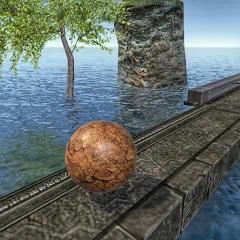
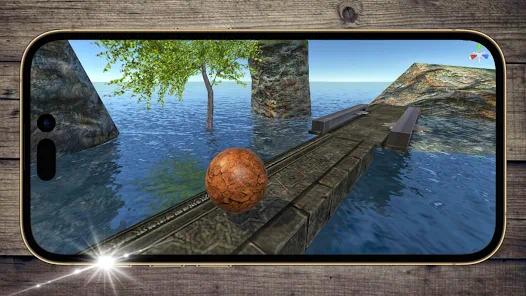
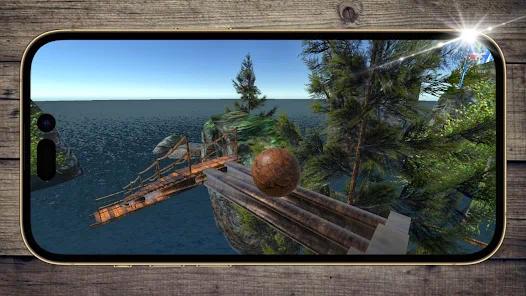
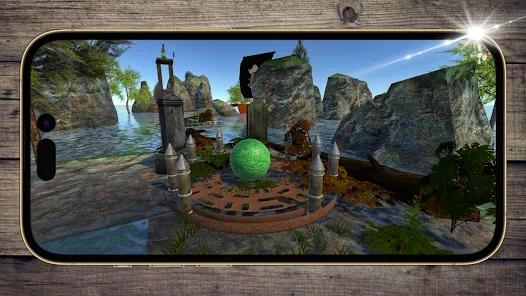
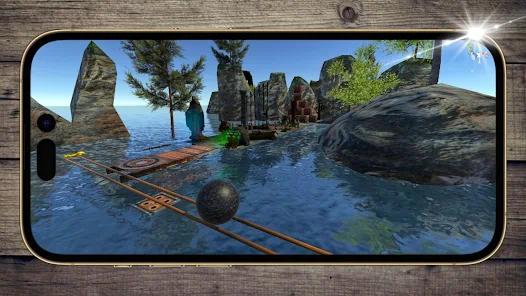
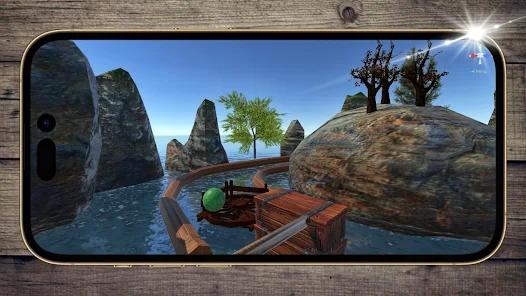
Ball Balancer 3: Extreme Ball, developed and published by SPDJ Media Pvt Ltd, represents a classic implementation of the 3D physics-based balance platforming genre. The primary gameplay loop requires players to navigate a physical sphere across 50 highly challenging levels suspended in water or open-space environments. The mechanics are heavily built upon a real-time rigid-body physics engine that dictates momentum, friction, and kinetic transfer. Players must navigate narrow wooden bridges, avoid explosive hazard barrels, and cross moving platforms to guide the sphere safely to an extraction boat.
The structural depth of the application is primarily driven by its material customization system, which goes beyond mere aesthetic shifts. The game offers three distinct ball materials that directly modify the sphere's physical properties:
- Hard Ball: High mass, low elasticity, high momentum retention, perfect for navigating wind-swept bridges or pushing past physical barricades.
- Soft Ball: High friction coefficients, swift deceleration rates, which can keep precision balancing on highly narrow, angled wooden beams.
- Bouncy Ball: High kinetic restitution, high vertical elastic bounce. It can cross gap voids and scale stepped vertical platform structures.
This material matrix forces players to analyze track conditions and adapt their sphere's physical profile to the obstacle layout. The control interface uses a discrete digital button layout (left, right, forward, backward) on the lower screen corners, coupled with an upward vertical swipe gesture to execute jumps. This design creates distinct pacing compared to continuous virtual joystick titles like Going Balls. The digital buttons force a step-by-step approach, making the gameplay feel more like a spatial puzzle than a high-speed arcade game.
However, the game's high difficulty is often compromised by performance issues. Players frequently report a "jumping lag" anomaly where frame rate drops cause swipe gestures to fail, leading to immediate falls off the suspended tracks. Additionally, the camera is locked to a semi-fixed chasing angle without manual pan controls. This layout restricts visibility around corners and down vertical slopes, presenting a significant hurdle during complex maze sections.
This challenge is further compounded by a aggressive ad-serving strategy. Unskippable interstitial ads run immediately before and after level attempts, which often breaks the concentration required to master the game's later stages.
Pros & Cons
Dynamic Material Physics: The integration of three distinct material states (hard, soft, and bouncy) alters mass, friction, and collision dynamics, offering tactical depth to level completion.
Structured Level Architecture: Featuring up to 50 progressive stages, the level design scales from introductory tutorials to complex spatial mazes.
Zero-Connectivity Requirements: The application is fully playable offline, making it highly resilient to connectivity drops and suitable for transit play.
Responsive Input Mechanics: The tactile split-screen layout isolates movement vectors from the vertical jump swipe, minimizing accidental input overlap.
Visual Environment Scaling: The 3D graphics utilize vibrant environment assets that maintain rendering stability across low-tier and high-tier hardware profiles.
- ✕
Inconsistent Jump Input Registration: Swipe gestures occasionally fail to register under low-framerate conditions, causing avoidable platform failures.
- ✕
Intrusive Ad Insertion: The placement of unskippable interstitial ads immediately prior to and post-level runs disrupts the gameplay loop and increases player fatigue.
- ✕
Camera Tracking Vulnerabilities: The camera tracking system exhibits lag during rapid directional adjustments, leading to blind spots on narrow ledges.
- ✕
Unforgiving Difficulty Spikes: The steep difficulty curve in later stages lacks intermediate checkpoints, forcing players to repeat highly frustrating segments.
Download
 Get it on Google Play
  Get it on App Store
 FAQs
How many distinct playable levels are featured in the game?
The game is built around a progressive matrix of 50 challenging levels, though some localized builds format this across 48 main stages.
What physical attributes change when switching between different ball skins?
Skins represent material profiles: the hard ball maximizes momentum, the soft ball maximizes friction/control, and the bouncy ball maximizes kinetic elasticity.
Can the application be played completely offline without data access?
Yes, the entire physics engine and progression database are localized, permitting full offline functionality.
What control inputs are available to navigate the sphere?
Movement relies on directional buttons (left, right, go, back) combined with a vertical swipe gesture to execute jumps.
Are there mid-level checkpoints to prevent restarting from the beginning?
Levels utilize a life system (typically 5 lives per run) which respawns the sphere at the last passed platform checkpoint before exhausting health.
Hot Reviews
The inclusion of distinct ball natures—soft, hard, and bouncy—completely shifts how one approaches obstacle courses, requiring strategic thought over simple reflex mechanics.
The gameplay is severely compromised by the deployment of back-to-back unskippable ads, which break the physical focus required to clear difficult levels.
Later levels present extreme mechanical difficulty, particularly on narrow, wind-swept bridges, without offering diagnostic hints or skip options.
The jump swipe gesture frequently suffers from processing lag, making precision landing maneuvers highly erratic and prone to failure.