Racing in Car 2


Overview
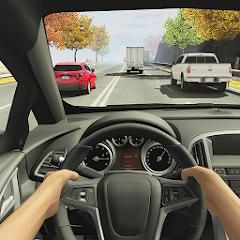
Mobile endless racing titles have traditionally relied on standard third-person, chase-camera perspectives that emphasize macro-environmental awareness over driver immersion. Published by Turkey-based studio ffgames (also operating under ckgames), Racing in Car 2 fundamentally diverges from standard genre tropes by anchoring its core gameplay loop entirely inside a 3D cockpit perspective. Released in November 2016 and continuously maintained through updates such as version 1.9, the title has amassed between 100 million and 500 million downloads, maintaining a low system footprint while providing lightweight simulation mechanics optimized for a broad spectrum of Android hardware.
The mechanical architecture of Racing in Car 2 centers on continuous forward movement through multi-lane highway traffic environments. Players steer their vehicle by leveraging mobile device gyroscopic accelerometer inputs, tilting the device left or right to execute precise lane changes and close-proximity overtakes. The core reward loop functions via distance-based currency accrual: the further a player drives without colliding into non-player character (NPC) traffic, the more gold coins are awarded. Taking operational risks—such as maintaining top velocity or threading between tightly packed civilian commuter vehicles—yields score multipliers and elevated coin yields. Accumulated earnings allow players to purchase faster vehicles featuring modernized interior dashboard graphics, improved engine audio, and higher top speeds, as well as distinct environmental tracks including urban, desert, and suburban highways.
From a technical standpoint, the game prioritizes high frame-rate stability over complex asset rendering. By restricting camera movement to a fixed interior origin point aligned with the steering wheel, the rendering engine eliminates the computational overhead of dynamic camera tracking, external vehicle mesh reflections, and complex chassis deformation physics. While the game lacks advanced control scheme options—such as touch-based virtual steering buttons or variable gyro sensitivity sliders—this structural constraint enables a virtually lag-free experience across legacy devices running Android 7.1 up to current Android iterations. Monetization relies on non-intrusive short interstitial advertisements triggered primarily upon run termination, supplemented by optional localized in-app purchases ranging from minor coin top-ups to complete ad-removal packs.
Pros & Cons
Immersive interior cockpit perspective delivers strong spatial driving awareness without visual clutter.
Exceptional frame-rate stability ensures consistent performance across low-end and legacy Android devices.
Unobtrusive advertising architecture keeps ad frequency low during active gameplay loops.
Highly responsive gyroscopic steering mechanics provide fluid lateral vehicle control.
Full offline playability allows complete access to core driving mechanics without an active network connection.
- ✕
Total absence of external camera views or adjustable interior viewing angles limits visual variety.
- ✕
Control inputs are strictly locked to device tilt, offering no virtual wheel, slider, or touch-button configurations.
- ✕
Static NPC traffic behavior reduces long-term procedural unpredictability and AI variance.
Download


FAQs
Does Racing in Car 2 require an active internet connection to play?
No, Racing in Car 2 operates as an offline title. Internet connectivity is only required if the player chooses to sync cloud achievements via Google Play Games or process in-app microtransactions.
Can players switch to a third-person chase camera perspective during gameplay?
No, the game is designed exclusively around a fixed first-person interior cockpit view. The developer intentionally excluded external camera perspectives to maintain its core simulator-style aesthetic.
How are coins earned to unlock new cars and environmental locations?
Coins are accumulated organically during endless driving runs based on the total distance traveled and high-risk maneuvers, such as passing within close proximity to NPC traffic at high speeds.
What control schemes are supported in the application settings?
The game relies on device tilt controls via the internal mobile gyroscope. On-screen touch buttons for steering are not currently implemented within the settings menu.
Does the game support saved progress synchronization across multiple devices?
Yes, players logged into Google Play Services can synchronize their achieved coins, unlocked vehicles, and high scores across supported Android devices.
Hot Reviews
Long-time players highlight the game's extraordinary optimization, emphasizing that its persistent lightweight build maintains smooth performance without frame drops across older tablet and smartphone models.
Users praise the intuitive motion controls, noting that minor hardware tilts translate into precise lateral shifts, making highway lane weaving accessible and responsive.
Reviewers frequently applaud the clear interior dashboards and detailed windshield perspectives, though many express a desire for alternate camera angles to view exterior car models.
Feedback consistently commends the game's offline availability, highlighting its utility as a dependable, lightweight mobile title during travel without cellular data.