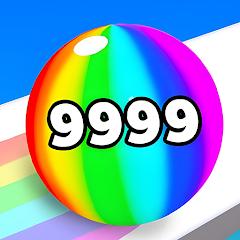
Numbers Ball Blend Challenge


Overview
The hyper-casual mobile gaming segment continues to experience rapid evolution, with developers increasingly relying on sensory-focused interaction loops to maximize user retention. The title Numbers Ball Blend Challenge represents a notable entry in this category. While traditional high-profile runners in this space challenge users with complex logarithmic numeric scaling—requiring continuous calculation of Base-2 exponentials () alongside rapid physical ball expansion—the design of Numbers Ball Blend Challenge chooses to prioritize continuous visual flow and real-time color transitions. This shift moves the core user experience away from traditional mathematical arithmetic. Instead, it focuses on real-time spatial organization, lane-switching reflexes, and quick pattern recognition.
The visual framework of the application is built around neutral, low-distraction 3D environments that emphasize high-contrast path layouts. The primary player objective is to guide a sphere along a multi-lane course, merging it with spheres of matching color to trigger real-time color transitions and transformations. This design minimizes the cognitive load typically associated with mathematical progression runners, replacing it with an aesthetic experience driven by real-time rendering shaders. These shaders adjust the sphere's chromatic properties dynamically upon a successful merge, providing immediate visual feedback that reinforces the gameplay loop.
From a technical and system architecture standpoint, the application runs on a lightweight rendering pipeline designed to maintain a consistent 60 frames-per-second performance, even on older, entry-level mobile devices. This efficiency is further supported by the game's compatibility with the Google Play Games on PC framework, powered by Intel technology. The desktop build utilizes hardware-assisted virtualization to run mobile game processes on desktop architectures. It requires a minimum hardware configuration of Windows 10, four physical CPU cores, 8 GB of RAM, and an Intel UHD Graphics 630 or comparable GPU to handle the real-time physics and color blends.
From a data privacy perspective, the application uses standard mobile advertisement SDKs to support its free-to-play model. Under Google Play's data safety guidelines, the developer discloses that the game shares approximate location data, personal identifiers, and device specifications with third-party advertising networks to facilitate targeted ad delivery. While all network communications are encrypted in transit, players should note that the system does not offer a direct mechanism for deleting collected user data.
Pros & Cons
The real-time shader system generates highly fluid and aesthetically pleasing color transitions upon successful merges.
Responsive, low-latency lateral swiping controls ensure precise navigation through tight obstacles.
The minimalist user interface keeps the screen free of unnecessary gauges, scoreboards, or persistent banners.
Optimized resource allocation allows for stable frame rates even on entry-level Android devices with basic GPUs.
Fully functional offline gameplay supports play sessions in environments without internet access.
- ✕
The game relies heavily on repetitive layout patterns, with lane structures and obstacle placements repeating across different stages.
- ✕
Inconsistent difficulty progression presents sudden, unexplained speed increases that disrupt the learning curve.
- ✕
Frequent full-screen interstitial ads interrupt the transition between levels, which can break the relaxing pace of the game.
- ✕
The lack of robust customization options, such as unlockable trails, skins, or custom audio tracks, limits long-term player retention.
Download

FAQs
Does the application require an active internet connection to play?
No, the core mechanics of the application are designed for local offline processing. An internet connection is only needed to load third-party ads and sync cloud saves.
How does the color merging logic differ from standard mathematical merge games?
Instead of using logarithmic arithmetic to scale the sphere's size, the system focuses on color matching. Merging spheres of the same color triggers smooth chromatic shifts, altering the track requirements dynamically.
What are the minimum system requirements for stable execution on Android?
The application requires Android version 7.1 or higher and at least 2 GB of available RAM for stable 60 frames-per-second performance.
Is there support for larger screens and PC architectures?
Yes, the title is optimized for the Google Play Games on PC framework, requiring a minimum of Windows 10, an Intel UHD Graphics 630 or equivalent GPU, and hardware virtualization activated.
How does the app handle player data privacy and tracking?
The game collects diagnostic identifiers, device specifications, and approximate location data, which are shared with third-party networks for advertising and analytic purposes.
Hot Reviews
The touch input is highly responsive, allowing for quick, precise lane changes. The color blending animations feel satisfying and deliver a polished visual flow.
The early stages are relaxing and easy to follow, but later levels introduce sudden, sharp turns and dense obstacle clusters that disrupt the gameplay rhythm.
While the core gameplay is highly relaxing, the frequency of unskippable ads between levels makes it difficult to maintain a consistent play session.
The game runs smoothly on older devices without causing thermal throttling or rapid battery drain, making it highly accessible.