
Zello PTT Walkie Talkie
Zello does the one thing it promises unusually well — it turns a phone into a walkie-talkie that works wherever there's data, is built for slow networks, and archives every transmission automatically. Two structural caveats decide whether it fits: everyone you want to reach has to be on Zello too, and published feedback alongside the listing's own note describes messages sitting in a pending queue during peak server load, which lands harder here than it would in most categories, because instant is the entire proposition.
- Teams that already think in radio terms — dispatch, delivery and logistics crews, construction and field-service groups — who want channel-based push-to-talk without the range limits of handheld radios, and who benefit from an automatic archive of every verbal instruction
- Anyone coordinating a group over slow or congested data, where a low-bandwidth voice tool beats a round of phone calls, and where mapping transmit to a volume key or a Bluetooth PTT button matters more than a polished chat interface
- Anyone who needs a channel that is instant every time — the documented server-queue lag means Zello shouldn't be the only line when timing is critical
- People whose contacts aren't on Zello: the protocol is closed and incompatible with other PTT apps such as Voxer and with carrier standards, so there's no meeting anyone halfway
- Users on tight battery budgets, since the persistent background connection that makes live audio arrive on a locked screen is also what significantly increases power draw



Overview
Zello is one of the rare apps we’d describe as replacing a physical object rather than competing with other software. The object is a two-way radio: hold a button, talk, everyone on the channel hears you at once — except the range is now wherever there’s data. Zello Inc has built that out with real care. It also carries one documented limitation sitting directly on that core promise, and it is what holds our score where it is rather than higher. The scale isn’t in question: 100M+ installs, 4.2 across roughly 748,453 ratings.
What it actually is
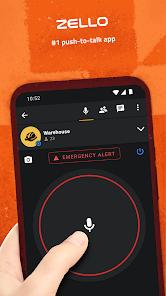
Push-to-talk over IP. Per Zello’s own FAQ, the app doesn’t use cellular voice minutes; it needs an internet connection — Wi-Fi, or mobile data over 2G, 3G, 4G or 5G — and streams digitized voice packets the moment you hold transmit. What you get is a radio’s interaction model: no dialing, no ringing, nobody deciding whether to pick up.
Zello keeps that model and drops the distance limit — which is why its natural buyer isn’t shopping for a messaging app, but currently carrying a radio that quits past the depot gate.
The low-bandwidth design, and why it matters
Zello’s protocol is built around keeping voice packets small. The developer’s position is that it transmits clear audio even over slow or congested 2G — a claim we attribute rather than verify, though published feedback from volunteers doing emergency coordination describes it working as a virtual radio on low-bandwidth networks. It’s the difference between a tool that needs good LTE and one that still gets a sentence through on a rural route.
Voice history is the quiet differentiator
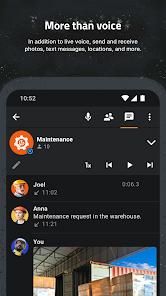
Every message you send and receive is recorded automatically and indexed for instant playback. It’s the feature we’d rate highest, and the hardest to replicate with a call or a radio — both vanish the moment they end. Published feedback credits it with settling disputes over verbal instructions in logistics work: someone says they weren’t told, and there’s a recording of them being told.
The FAQ covers cleanup: local recordings are removed via the Options menu and “Clear History.” Worth stating plainly, as a product property rather than an accusation: automatic recording of all voice traffic is always running — useful for record-keeping, and something everyone on a channel should understand is happening.
Buttons, headsets and hands-free use
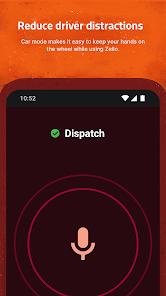
Zello supports wired and Bluetooth headsets plus dedicated wireless PTT hardware buttons, and it lets you map transmit to the phone’s physical volume keys. That last option is small and disproportionately liked — one of the recurring positives in published feedback — because you can transmit without unlocking or even removing the phone, which with hands on a steering wheel is the entire point. The persistent background service backs it up: transmissions arrive with the screen locked.
Channels at scale, and Solo mode
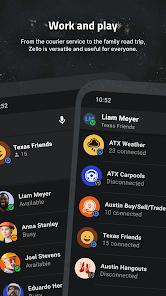
Channels — public or private — support up to 6,000 active users, per Zello’s stated figure. That ceiling targets large-scale coordination rather than a group chat, but a busy channel creates its own problem: several feeds talking over each other.
Solo mode is the answer. Toggle it and Zello silences your other contacts and background channels, routing their audio into the local history log instead of your speaker. Well-judged design: the audio isn’t discarded, it’s deferred.
The server queue is the most serious criticism
Here’s the part to read twice. Both the store description and recurring themes in published user reviews describe the same behaviour: during peak server load, voice messages can be held in a pending queue for up to several minutes before they transmit. The listing acknowledges this directly, and states the latency can disrupt operations in critical scenarios. It even names the mechanism, describing the app as sensitive to “packet delivery queue bottlenecks during peak server loads” — the vendor’s own words, not our diagnosis.
For most apps, a delay under heavy load is an inconvenience. For this one it lands squarely on the value proposition, because the entire reason to choose push-to-talk over a phone call is that it’s immediate. A voice message arriving minutes late isn’t a slower version of the feature — it’s a message the sender believes has already landed, acted on as though it were heard. That asymmetry is what makes queue lag different from ordinary slowness: the failure is invisible from the transmitting end.
To be precise about what we are and aren’t saying: this is documented recurring feedback in published reviews plus the vendor’s own acknowledgment. We have not measured it, we make no claim about how often it happens, and nothing here says the queue is the normal experience. It remains the most consequential thing on this page: it is the one criticism aimed at the feature the product is named for.
Who relies on it, and what that means
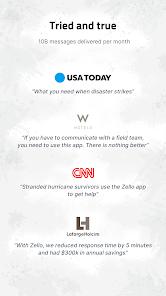
The listing notes that Zello is used in disaster relief, and that it played a documented role in coordinating civilian action during public protests in Kenya and Zimbabwe, where cellular voice networks were congested or restricted. We report it as context for why the app exists in the form it does, and take no position on the events involved.
The plain product observation holds both facts together: people do rely on Zello when things go wrong, and the documented queue lag is exactly why it shouldn’t be anyone’s only channel when the stakes are high.
Battery is the bill for background operation
Maintaining a persistent socket so live audio can arrive at any moment significantly increases battery drain. That isn’t a bug awaiting a patch — it’s the direct cost of the always-listening behaviour. On a long shift, a Zello phone wants a charger in the vehicle.
Privacy and security: what each tier offers
Reporting the FAQ exactly: private channels are protected by passwords. Public channels are open — by design, since a public channel is meant to be joinable. Enterprise-level security with encryption is a separate, paid product called ZelloWork.
The fair reading: password-protected is not the same as end-to-end encrypted, and the FAQ places encryption in the paid enterprise tier. We aren’t alleging the consumer app is insecure and we know of no incident; we’re describing where the vendor draws the line. Our material carries no pricing for ZelloWork, so check current terms with Zello.
Protocol lock-in: everyone has to be on Zello
Zello runs a custom, closed protocol that is incompatible with other PTT apps — Voxer among them — and with carrier standards. The practical takeaway: every person you want to hear from installs Zello, or they’re not on the channel. For one crew under one manager, that’s a five-minute onboarding. Across organizations standardized on something else, it’s the deciding factor before any feature comparison.
How it compares
We won’t rank Zello against rivals we haven’t assessed on the same terms, so take the product’s own framing. Against a handheld radio, Zello trades range limits and hardware for a dependency on data coverage and a vendor’s servers; against a phone call, it trades the certainty of a dialed connection for speed, one-to-many delivery and a searchable archive. Both trades are reasonable — once you’ve priced in the queue behaviour and the everyone-on-one-app requirement.
A note on recency
The Play listing shows an update dated March 23, 2026 — current maintenance for a product this size. Since the complaint that bears hardest on the premise is server-side, infrastructure investment matters more here than anything on a changelog.
Who it’s not for
Anyone who needs a channel that is instant every time shouldn’t make Zello their sole line — the documented lag is the vendor’s own caveat, not ours. It’s a poor fit if the people you need to reach aren’t already on it; the closed protocol leaves no bridge. Users who need encrypted traffic won’t find it in the consumer app; that’s what ZelloWork is for. Anyone running a phone hard all day without charging should weigh the power draw. And casual users swapping voice notes with a friend are over-served here.
Our take
Zello earns its 4.2. The core idea — a radio with no range limit — is executed with care, and the details give it away: volume-key mapping, hardware PTT support, Solo mode deferring muted channels into history, and an automatic archive that solves a problem radios never could.
What keeps us at 4.1 rather than higher is that the most serious documented complaint targets the promise itself: an app built on being instant that can, under peak server load, hold a transmission in a queue carries a caveat no feature list offsets. Add the closed protocol, and the honest summary is this — Zello is an excellent tool for groups who can all commit to it and who keep a fallback for the moments that truly can’t wait, and a harder call for anyone who needs one channel to be right every time.
How We Evaluate
We did not hands-on test this app. This review is a desk assessment grounded in Zello PTT Walkie Talkie's Play Store listing and description, its stated feature set, the pros and cons recorded in our app database, its published FAQ, and the recurring themes across its user reviews. We also weighed its 4.2 aggregate rating from roughly 748,453 ratings alongside 100M+ installs, six screenshots, a March 23 2026 Play update, and its public reputation as a push-to-talk tool from developer Zello Inc. Where we describe a strength or a limit, we trace it to those signals rather than to personal use. Specifically: the low-latency streaming protocol, the 6,000-user channel ceiling, the low-bandwidth performance claims and the security description of ZelloWork are the developer's stated positions, which we attribute to Zello rather than assert as verified. The server-queue lag we describe reflects documented recurring feedback in the published reviews plus the listing's own acknowledgment — we have not measured it, and we make no claim about how often it occurs. Our material contains no pricing for ZelloWork or any paid tier, so we quote none.
Pros & Cons
Unlimited Global Communication: Replaces physical radio distance limitations by routing low-latency voice packets globally over IP networks.
Automated Audio Archiving: Automatically records and indexes every received and transmitted voice message, allowing instant playback for record-keeping.
Physical Key Mapping: Allows users to map dedicated physical buttons (like volume keys or Bluetooth PTT accessories) to trigger transmissions hands-free.
Scalable Group Channels: Supports massive public or private channels of up to 6,000 users, making it ideal for large-scale coordination.
Low-Bandwidth Optimization: Designed to transmit clear, digitized audio packets even over slow or congested 2G cellular networks.
Background Operation Mode: Runs as a persistent background service, allowing users to receive voice transmissions even when the device screen is locked.
- ✕
Server Queue Lag: Heavy network traffic can cause messages to sit in a pending queue for up to several minutes before transmitting.
- ✕
Proprietary Protocol Lock-In: Uses a custom, closed protocol that is completely incompatible with other PTT apps like Voxer or carrier standards.
- ✕
Background Power Consumption: Maintaining a persistent background socket connection to receive live audio feeds can significantly increase battery drain.
Download


FAQs
Does Zello require a mobile data plan to function?
Zello does not use cellular voice minutes, but it does require an active internet connection (Wi-Fi or mobile data) to transmit voice packets.
How do I prevent channels from overlapping?
Users can set their status to "Solo," which automatically mutes all other contacts and background channels, routing their audio to the history log for later playback.
Can I use a Bluetooth headset with Zello?
Yes, Zello supports a wide variety of wired and Bluetooth headsets, as well as specialized wireless PTT hardware buttons.
How do I clear my stored voice history?
To delete your locally saved audio recordings, go to the Options menu in the app and select "Clear History".
Is Zello private and secure?
While private channels require passwords, public channels are open. For enterprise-level security, Zello offers a separate, paid "ZelloWork" service with encryption.
Hot Reviews
Logistics managers appreciate the automated voice history archive, noting it resolves disputes by keeping an indisputable record of verbal instructions.
Disaster relief volunteers praise Zello's performance, stating it operates reliably as a virtual radio even on low-bandwidth networks during emergency coordination.
Several users note that during peak traffic, messages can get stuck in a transmission queue for several minutes, causing communication delays.
Reviewers love the ability to map the push-to-talk function to their phone's physical volume buttons, allowing them to communicate hands-free.