Universe Master - Break The Ea


Overview
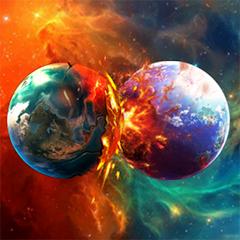
Universe Master, developed by MStudio, is a celestial physics simulation application and space sandbox game that allows users to create, modify, and destroy custom planetary systems within an interactive gravitational environment. Functioning as both an educational physics tool and an interactive space sandbox, the game gives players freedom to manipulate stellar physics, manage celestial body orbits, and launch cosmic weapons against target star systems.
The physics engine of Universe Master centers on star and planet generation. Users can forge various stellar classifications—including main-sequence stars, white dwarfs, red dwarfs, protostars, massive red giants, and hyper-dense neutron stars—and build surrounding planetary orbits featuring real or custom planets like Earth, Mars, Jupiter, Saturn, and Neptune. The simulator models n-body gravitational attraction, allowing players to experiment with orbital resonance, planetary collisions, atmospheric changes, and black hole gravitational lensing.
The gravitational sandbox loop operates across three primary stages:
- Stellar Body Creation: Spawning central stars ranging from protostars to neutron stars and configuring custom planetary masses.
- Orbital Mechanics Simulation: Establishing stable gravitational orbits, monitoring n-body gravitational forces, and managing black holes.
- Asymmetrical Solar Raiding: Deploying meteor swarms and directional gravitational pulls in PvP mode to destroy rival star systems.
Universe Master integrates casual progression and competitive multiplayer elements alongside its core physics sandbox. It includes an offline idle material auto-collection system that earns cosmic resources over time to unlock exotic star classes and black hole phenomena. Additionally, the game features a unique player-versus-player (PvP) attack mode, enabling users to launch meteor storms and rogue celestial bodies to disrupt and shatter friend-created star systems. Monetization centers on voluntary reward ads and optional in-app purchases for specialized cosmic materials, keeping the core physical sandbox open to players.
Pros & Cons
Interactive stellar physics sandbox enabling full creation, customization, and destruction of solar systems.
Wide variety of stellar bodies including protostars, white dwarfs, red giants, superdense neutron stars, and black holes.
Unique competitive PvP mode allowing players to launch meteorites and destabilize rival planetary systems.
Offline idle resource auto-collection mechanism that rewards steady account expansion.
Accessible user interface and touch controls for adjusting orbital trajectories and velocity vectors.
- ✕
Visual presentation and orbital particle effects are basic compared to high-end astronomical rendering engines.
- ✕
Intermittent interstitial ad placements during extended sandbox experimentation sessions.
- ✕
Simplifies complex astrophysics formulas to maintain high mobile frame rates.
- ✕
Limited save slots for preserving multiple complex solar system configurations simultaneously.
Download
 Get it on Google Play
  Get it on App Store
 FAQs
How does the solar system creation mechanic operate in Universe Master?
Players spawn a central star, select planetary mass types, set initial velocity vectors, and establish stable gravitational orbits using touch drag controls.
Can black holes be spawned in Universe Master?
Yes. Players can drop active black holes into custom star systems to observe real-time gravitational lensing, orbital disruption, and planetary consumption.
How does the PvP attack mode function?
In PvP mode, players load a target star system created by another player and deploy meteorites, asteroid clusters, or directional gravitational shifts to destroy its planets.
Is Universe Master playable without an active internet connection?
Yes. The core physics creation sandbox and single-player solar system simulation function fully offline without requiring Wi-Fi.
What are the PC system requirements for Universe Master?
When run via Google Play Games PC, the app requires Windows 10, an Intel UHD Graphics 630 or equivalent GPU, 4 CPU physical cores, and 8 GB of RAM.
Hot Reviews
Space enthusiasts enjoy the balance between creative sandbox construction and catastrophic destruction. Spawning a dense neutron star in the middle of a stable planetary arrangement to watch orbital paths distort offers satisfying casual physics gameplay.
Reviewers highlight the PvP attack mode as a novel concept. Being able to challenge a friend's solar system design by calculating meteorite trajectory angles adds a playful competitive dynamic to the sandbox format.
Casual players appreciate the intuitive controls, though some advanced astronomy hobbyists note that gravitational formulas are streamlined for mobile performance rather than pure academic accuracy.
Feedback commends the idle auto-collection mechanics, allowing casual players to acquire rare space materials and unlock black holes over time without constant active grinding.