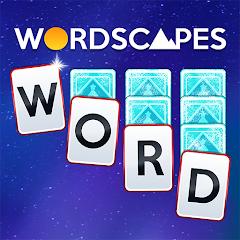
Wordscapes Solitaire
A word-and-solitaire hybrid where the two halves run together rather than in turns — our source material describes sorting letter-bearing cards and building words as a single action — and it carries a 4.6 average across 211,661 ratings. One caveat is specific enough to settle before you install: our own database entry records the ad load changing at level 75, to full-screen, unskippable video after every completed level.
- Players who want a word puzzle without a clock — our database records the absence of strict timers as a design strength, crediting it with leaving players free to focus on strategic layout planning and word building
- Anyone drawn to the collecting side of word games: our source material records a 'Library of Lost Words' that indexes the terms you build and surfaces historical definitions for rare and archaic vocabulary drawn from global cultures
- People who play without a connection — our records state that the local dictionaries and core card engines run on-device, so the puzzle itself works with no network data or Wi-Fi
- Players who enjoy presentation as part of the reward — our database credits high-quality, culturally inspired artwork that changes as you progress, and our FAQ records unlockable visual themes and custom card backings
- Anyone whose priority is an uninterrupted, low-friction session past the early game — our own database records full-screen, unskippable video ads after every completed level once you pass level 75
- Players who expect to browse their collection later: our database records the interface lacking a dedicated lookup feature for viewing and tracking unlocked words, and a recorded feedback theme says the same
- Long-session players sensitive to sameness — our database records card distribution occasionally reusing similar letter patterns over extended play
- Anyone playing on a low battery or an older phone with poor endurance, given the high battery consumption our database attributes to rendering the high-definition backgrounds
- Anyone shopping for a verified vocabulary-building or brain-training product — the cognitive framing in our material is our own database's characterization, not an effect we have measured, and we hold no research on it


Overview
Most genre hybrids make us nervous — two loops sharing a screen and competing for attention rather than combining. Our records describe the other arrangement: the cards you sort are the letters you spell with, so the layout move and the word are one move. A 4.6 average across 211,661 ratings says a large audience is broadly happy. What we would settle before installing is the one number our material states precisely — level 75, after which our database records full-screen, unskippable video ads after every completed level.
What the board actually asks of you
Our database entry describes a blend of classic solitaire card-stacking with spatial, anagram-style word puzzles: you build valid words out of dealt letter cards, running layout strategy and word recognition together rather than in sequence. Our FAQ compresses the loop into a line — players select and arrange letter-bearing cards from a solitaire layout to construct valid words, clearing the board to advance. A recorded feedback theme reads the same from the player’s side: praise for the blend of solitaire and word construction, described as a highly engaging, relaxing mental workout.
Our records stop there. They do not say how cards are dealt, whether wildcards exist, how scoring works or what counts as a valid word, and we will not fill those gaps with what solitaire normally does, since a hybrid’s familiar rules may not carry over. The framing our material adds: vocabulary-based card sorting in place of numerical sequencing.
Our database lists the absence of strict timers as a strength, crediting it with leaving players free to focus on strategic layout planning and word building. Where the hard part is retrieving the word, removing the countdown removes the penalty for thinking — and that defines who this suits more than any theming.
The Library of Lost Words, and a gap our records disagree about
Our source material calls the Library the game’s primary progression engine, doubling as theme and measure of vocabulary growth. As you clear card piles into valid words, the terms are indexed in an in-game glossary and rewarded with historical definitions and culturally themed backgrounds, with an emphasis on rare and archaic vocabulary drawn from global cultures. Our FAQ calls it the catalog where players collect, view and read those definitions.
Our cons list then records something that does not sit comfortably beside that: the interface lacks a dedicated lookup feature for viewing and tracking unlocked words in the Library. A recorded feedback theme runs both ways on the same point — collecting rare words is enjoyable, but there is no simple index for reviewing collected terms afterwards.
We are not going to quietly reconcile those. Parts of our own material disagree about how browsable the collection is, and we cannot settle it from what we hold. If collecting is your main reason for installing, treat after-the-fact browsing as unconfirmed rather than promised.
Level 75, stated exactly
This is the most specific claim in our material, and the likeliest to decide whether you keep the app. Our database entry records that the early stages offer a balanced ad-to-play ratio, and that reaching level 75 triggers a sharp increase in ad frequency, with full-screen, unskippable video ads running after every completed level. Our cons list restates it, and a recorded feedback theme adds the player-side view: frustration at the increase, with the constant interruptions described as ruining the relaxing flow. That is our records talking, not an ad load we have sat through.
Then scope it. On record: a threshold at level 75, a cadence of after every completed level beyond it, and ads described as full-screen and unskippable. Not on record: how long a spot runs, whether a skip appears after a countdown, whether the cadence escalates further, and any exact level count — our material says only that the loop runs across hundreds of levels, so we cannot say what share sits past that line.
Our FAQ answers the why, and we quote rather than paraphrase it: the game “uses a dynamic monetization model that increases ad frequency as players progress to monetize highly engaged users.” That is our editorial database’s answer, not a statement from PeopleFun, so it should not be read as the developer conceding anything — and it is an explanation our own material offers for a documented pattern, which we report as written without adopting any conclusion about intent.
The rest of the monetization picture is blank in our records — an absence in our data, not a confirmed absence in the app. No price, no ad-removal purchase, no subscription and no in-game currency appears in our entry, and free games routinely carry purchases a third-party record does not list, so read the in-app purchase line on the Play listing yourself.
The cognitive framing, attributed rather than adopted
Our material reaches for cognitive language in three places: reasoning about exercising two distinct areas of brain function, a pro headed “Encourages Vocabulary Growth,” and another headed “Balanced Cognitive Exercise” crediting simultaneous stimulation of spatial reasoning and lexical recall. The same entry says the Library expands spelling and word retrieval skills.
All of that is our own editorial database’s framing — not the developer’s, and not a finding of ours. We have verified none of it, hold no research on it and cite no study, so nobody should install this as a vocabulary or brain-training product on our recommendation. We are not arguing the opposite either; we have simply not measured it. What is documented is narrower: this is a game that makes you find words, and our records say it hands you a definition for the rare ones.
Backgrounds, battery, and the trade between them
Our database credits high-quality, culturally inspired artwork that changes as you progress, and our FAQ records that campaign progress unlocks further visual themes and custom card backings. A recorded feedback theme highlights the backgrounds and smooth animations as feeling polished and premium — that theme’s characterization, not ours.
The cost is recorded in the same entry: high battery consumption, with the rendering of those high-definition backgrounds held responsible for draining battery faster than a standard, flat word game. We hold no measurement, test device or comparison figure, so treat that as our database’s observation rather than a benchmark — but weigh it if you play on a half-charged commute.
Repetition and offline play, as recorded
Our database’s remaining criticism is milder and should stay that way: card distribution can feel repetitive over extended sessions, occasionally reusing similar letter patterns. Note both qualifiers — a long-session complaint about letter patterns, not a claim that whole boards repeat. It sits in tension with the same entry’s line about the loop staying engaging across hundreds of levels; both are our material’s, and we let them stand.
Offline access is recorded as reliable, with the dictionary databases and core card engines running locally so the game is playable with no internet connection; our FAQ says the same in different words, and the Play category on record is Offline. Both statements are scoped to the puzzle itself, and we will not widen them into “fully offline.”
Recency, scale, and what we do not carry over
On maintenance we hold one date — a Play update of March 18, 2026, roughly five months before this review — plus six screenshots, 1M+ installs and PeopleFun as the developer. We hold no changelog, so we cannot say what changed. Our records note no relationship between this app and any other title from the studio, so we draw none.
One handling note. All four recorded feedback themes carry a five-star label, including the two whose text describes frustration with the ad load and the missing word index. We read them as sentiment summaries written by our team rather than verbatim reviews with real stars attached, so we weighed what they say and set the stars aside.
Who it’s not for
Five groups should think twice: anyone who wants an uninterrupted session past the early game, given the post-level-75 ad cadence our records describe; players who expect to browse their word collection later, given the missing lookup feature and our records’ disagreement about it; long-session players sensitive to the reuse of letter patterns; anyone on an endurance-limited phone, given the recorded battery cost; and anyone shopping for a proven vocabulary or brain-training tool, since we have verified nothing of the sort.
Our take
The hybrid is the good idea here, and our records make a coherent case for it: one action that is both a card placement and a word, no timer pressing on recall, a collection layer that rewards you with something to read, and artwork that changes as you go. A 4.6 average across 211,661 ratings is a large audience broadly agreeing. We land a little under that at 4.2, and the gap is mostly one documented thing — the level-75 threshold, after which our database records full-screen unskippable video following every completed level — with the missing Library index, the battery cost and the letter-pattern repetition making up the rest. If you play in short bursts, or the collecting and the artwork are what you came for, this is an easy install. If you want a no-timer word game precisely because the session should stay calm all the way through, settle that threshold first.
How We Evaluate
We did not hands-on test this game. This is a desk assessment built from Wordscapes Solitaire's Google Play listing and from our own editorial database entry for the app, which is an analytical write-up by our team rather than store marketing copy — a distinction that matters here, because several of the sharper observations below come from that entry and should not be read as anything the developer said. We weighed the six pros and four cons recorded in our database, our database's FAQ, and four recurring themes in published user feedback, which we treat as sentiment summaries written by our team rather than verbatim user quotes. The store signals on record: a 4.6 average across 211,661 ratings, 1M+ installs, six screenshots, a March 18 2026 Play update, an Offline category listing, and PeopleFun as the developer. Four limits we state rather than paper over. We describe the rules only as our material describes them — it does not say how cards are dealt, whether wildcards exist, or how scoring works, so neither do we. We have verified no vocabulary, cognitive or brain-training effect, hold no research on it and cite no study. No pricing, ad-removal purchase, subscription or in-game currency appears anywhere in our records, so we make no claim about what anything costs or what money would change. And two parts of our own material disagree about whether the word Library can be browsed after the fact; we report the disagreement rather than picking a side.
Pros & Cons
Innovative Hybrid Design: Combining card layout sorting with spelling puzzles delivers a fresh, engaging twist on casual brainteasers.
Encourages Vocabulary Growth: The "Library of Lost Words" rewards players for discovering rare, archaic, and culturally diverse terms.
Paced, Low-Stress Puzzles: The absence of strict timers allows players to focus on strategic layout planning and word building.
Elegant Visual Backgrounds: Features high-quality, culturally inspired artwork that dynamically changes as players progress.
Balanced Cognitive Exercise: Simultaneously stimulates spatial reasoning and lexical recall, keeping players mentally active.
Reliable Offline Access: The dictionary databases and core card engines run locally, allowing players to play without an internet connection.
- ✕
Aggressive Ad Frequency: Post-level 75, the game displays unskippable video ads after every completed level, disrupting the gameplay flow.
- ✕
Repetitive Card Dealings: Card distribution algorithms can feel repetitive over extended play sessions, occasionally reusing similar letter patterns.
- ✕
Unclear Word Tracking: The interface lacks a dedicated lookup feature to easily view and track unlocked words in the Library.
- ✕
High Battery Consumption: Complex rendering of high-definition backgrounds can drain device battery faster than standard, flat word games.
Download

FAQs
How do the hybrid mechanics of Wordscapes Solitaire work?
Players select and arrange letter-bearing cards from a solitaire layout to construct valid words, clearing the board to advance.
What is the "Library of Lost Words"?
It is the game’s primary progression catalog where players collect, view, and read historical definitions of rare words unlocked during play.
Does the app support offline play?
Yes, the core card engines and local dictionaries are fully accessible without network data or Wi-Fi connectivity.
Why does the frequency of ads increase after level 75?
The game uses a dynamic monetization model that increases ad frequency as players progress to monetize highly engaged users.
Can players customize the background artwork or card styles?
Yes, progressing through the campaign unlocks a variety of culturally inspired visual themes and custom card backings.
Hot Reviews
Reviews praise the seamless blend of solitaire and word construction, with many players noting it offers a highly engaging, relaxing mental workout.
Players express frustration with the dramatic increase in ad frequency after level 75, stating that the constant interruptions ruin the relaxing flow.
Users point out that while collecting rare words is fun, the game lacks a simple index to track and view collected terms in the library.
Positive reviews highlight the beautiful backgrounds and smooth animations, which make the puzzle experience feel polished and premium.