Geometry Dash
A precision rhythm platformer that does something genuinely rare on mobile: a single upfront purchase covers every official level and cosmetic, with no ads and no microtransactions. The deciding factor is fit rather than value — the later levels are documented as unforgiving for casual players, and some Android devices see framerate stutters that pull inputs out of sync with the music.
- Players who want a precision challenge to work at over weeks — reading a level's rhythm, drilling one hard segment in Practice Mode, and treating a clean run as the reward
- Anyone tired of ad breaks and currency stores who wants a one-time paid game with a deep level editor and a bottomless community catalogue behind it
- Casual players looking for something relaxing in two-minute gaps — the late-game official levels and extreme custom levels are documented as incredibly unforgiving for casual players
- Anyone who needs to try a game before paying, or who specifically wants a regular drip of new official content — major developer updates are spaced years apart


Overview
A lot of mobile games open by asking what you will tolerate — how many interstitials, how many timers, how many nudges toward a store page. Geometry Dash asks something rarer and harder: whether you will fail the same few seconds of a level over and over before it clicks. The store signals say plenty of people are willing — 4.7 across roughly 867,000 ratings, 10M+ installs — and that the players who click with this game click very hard. What they cannot tell you is whether you will be one of them, and here that question comes first: the paying happens before the finding out.
What it actually is
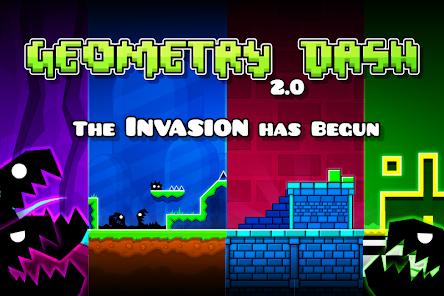
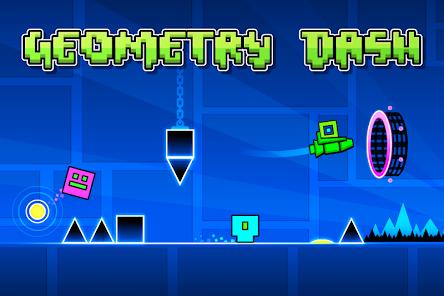
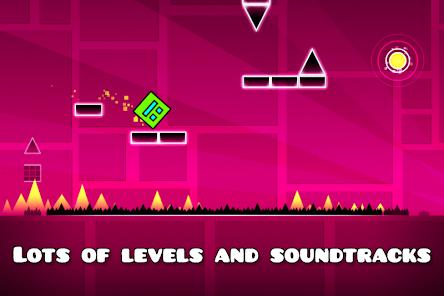
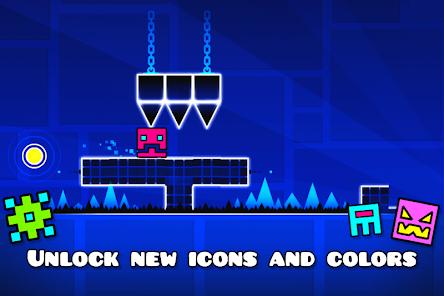
A one-touch rhythm platformer. Your icon auto-runs left to right through spikes, buzzsaws and moving hazards, and your entire input vocabulary is a tap to jump. The hook is that those hazards are laid out in time with an electronic soundtrack, so after a few attempts you stop reading the screen and start playing the song. Contact with anything ends the run, and there are no checkpoints outside Practice Mode — that is the whole reason Practice Mode’s manual checkpoints exist — so progress is counted in attempts rather than lives.
Transformation portals are the variety engine
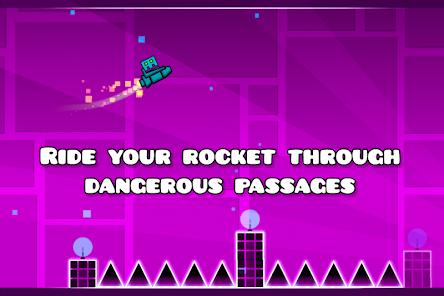
A one-button game ought to go stale quickly; the portal system is why this one does not. Passing through a transformation portal swaps your vehicle and its physics outright — the jumping cube becomes a gravity-flipping ball, a rocket-propelled ship, a UFO, a momentum-carrying wave, or a swinging robot, each changing what the tap does. The friction worth naming: muscle memory does not transfer between forms, so a player comfortable with cube timing can hit a ship section and find their instincts working against them, and since levels chain several forms together, the switch itself becomes part of the difficulty rather than just the hazards around it.
The monetization reality, stated plainly
This part genuinely stands apart, and deserves accuracy rather than applause. Geometry Dash uses a traditional premium model: one upfront purchase covers all official levels, rewards and character cosmetics. No ads. No paid expansions. No pay-to-win microtransactions. Where free-to-install and monetise-forever is the default, that is unusual enough to be the most-cited theme in published feedback, framed there as the game respecting a player’s time and wallet.
Two caveats. We are not quoting a price — our data does not include one, so check the current figure on the store listing. And paying upfront inverts the usual risk: on a free game you find out whether you like it and then decide about money; here you decide first, which matters given how sharply this game divides players. The FAQ confirms official campaign levels and previously downloaded custom levels play offline, and the developer declares the app shares no user data with third parties and collects only minimal diagnostic data encrypted in transit — a declaration, not an audited finding.
The level editor and the community pipeline
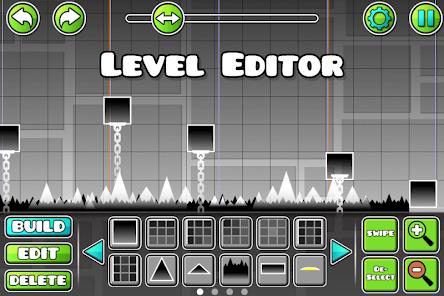
The built-in editor is closer to a visual game engine than a level tool: custom triggers, visual effects, and music tracks that creators link from the Newgrounds audio library for players to download in-game. Millions of custom levels have come out of it, and that catalogue is why the game has lasted. The caveat is inherent to any user-generated library: the range is enormous, quality is uneven, and the discovery work falls to you. The extreme end of that catalogue also carries the same warning our con list gives the late official levels — incredibly unforgiving for casual players — so the hardest material here is not necessarily the official kind.
Practice Mode and the difficulty reality
Practice Mode is the concession that makes everything else learnable: manual checkpoints let a hard segment be drilled in isolation instead of re-earned from the level’s start each time — the difference between the late game being a wall and being a project. It is a rehearsal tool, though; the clean run still has to happen for real.
The difficulty is the central audience-fit fact, so we will be direct in both directions. The later official levels and the extreme end of the custom catalogue are documented as incredibly unforgiving for casual players. “Demon-tier” is the community’s own shorthand for the hardest levels, and published feedback treats it as both a draw and a warning — reviewers describe those completions as demanding intense patience and delivering a real sense of achievement. Other players will decide inside an hour that this is not how they want to spend their attention, and that is a taste mismatch rather than a deficiency on their part. Working out which one you are before you buy is the most useful thing we can tell you.
Platformer Mode
Recent updates added Platformer Mode, a bigger change than it sounds. Classic levels force constant forward movement; Platformer Mode hands you manual left-and-right control and lets you set your own pace, turning the same physics and hazards into something closer to a conventional 2D platformer. It is the most meaningful accessibility lever the game has: setting your own pace removes a whole category of pressure.
The stutter problem
The most concrete technical criticism, and a serious one: some Android models experience occasional framerate stutters that pull inputs and music out of sync. Published feedback describes it precisely — the screen slows while the music stays on beat, throwing off jumps timed to that beat. In most games a stutter is an annoyance; here, where the correct input is defined by the music, it undermines the exact thing being asked of you, and can read as a failure of your own timing. On scope we are careful: this is documented on some devices, and we cannot say how common it is or which hardware is affected.
The update cadence
Major official content updates are spaced years apart. If you want a steady stream of developer-designed levels, that is a slow clock and a fair reason for the game to fall short of your expectations. The mitigation is real: because the editor and community pipeline are first-party features, the flow of new levels does not depend on the update schedule. Whether that satisfies you depends on whether you want developer-made content specifically or simply more good levels.
How it compares
The useful comparison is not to another title but to the prevailing mobile model, which monetises attention: ad breaks between attempts, currencies, timers, cosmetics behind a store. Geometry Dash’s pitch is the opposite trade — you pay once at the door and it never asks again. Its advantages against that norm are the absence of interruption, an editor with real depth, and a community catalogue no single studio could match for volume. The trade-off is accessibility: nothing here is engineered so that your first ten minutes cannot go badly.
A word on recency
Two separate facts, which we will not run together. First, Google Play shows no public “updated” date for this listing, so we cannot say when it was last patched. Second, major official content updates are documented as arriving years apart, which is a cadence and not a diagnosis. The missing date is not evidence of neglect; it just means the usual recency signal is unavailable here. What we can point to: 10M+ installs and a 4.7 average across roughly 867,000 ratings from developer RobTop Games — a strong result for a game this demanding.
Who it’s not for
Anyone who wants a game to unwind with. Classic mode has no checkpoints outside Practice Mode, and the later content is documented as incredibly unforgiving for casual players — if your mobile gaming happens in two-minute gaps and you want progress every time, this will not deliver it. It is also not for players who need to try before buying, since the purchase comes first — or for anyone wanting a regular drip of new official content.
Our take
Geometry Dash is one of the few mobile games where the business model is a feature rather than a cost: one purchase, every official level and cosmetic, no ads and no microtransactions. Add a deep editor and an endless community catalogue, and it is a substantial thing to own. We land on “situational” purely on fit: the difficulty is not a flaw to be fixed — it is the product — but it does mean a meaningful share of buyers will find the game is not for them after they have already paid. The stutter reports on some Android devices are the one defect we would call serious, landing on the mechanic everything else rests on. Go in wanting a precision challenge you will work at over weeks, reach for Practice Mode early, and check the current price on the listing first. If that reads as a chore rather than a hobby, this is a well-made game that is simply not aimed at you.
How We Evaluate
We did not hands-on test Geometry Dash. This review is grounded in the game's own Google Play listing and description, its stated features (the one-touch rhythm gameplay, the transformation portals and vehicle physics, the built-in level editor, Practice Mode, Platformer Mode, the Newgrounds audio integration and the premium purchase model), the pros and cons recorded in our database, the listing's FAQ, the recurring themes in published user feedback, and its store signals — a 4.7 average across roughly 867,000 ratings with 10M+ installs and 6 screenshots, from developer RobTop Games. Two points of honesty about the limits of that basis. Google Play shows no public "updated" date for this listing, so we cannot tell you when it was last patched and we do not guess. And no price appears in our source data, so we do not quote one — check the current figure on the store listing before buying. Where we cite user sentiment, including the difficulty and the framerate-stutter reports, we are reflecting documented recurring feedback rather than our own play sessions.
Pros & Cons
Pure Premium Ad-Free Model: A clean, focused user experience with absolutely no ads, paywalls, or hidden microtransactions.
Incredibly Deep Level Editor: A powerful creative tool that lets players design and share highly detailed, custom levels.
Perfect Audio-Visual Synchronization: Excellent integration of electronic music and level design, helping players learn timing through rhythm.
Highly Useful Practice Mode: Allows players to place manual checkpoints, making it easier to practice and master difficult sections.
Active Global Community: An endless stream of user-generated levels, online leaderboards, and competitive events keeps the game fresh.
Diverse Vehicle Mechanics: Transformative portals provide constant gameplay variety by changing the physics and controls mid-run.
- ✕
Stray Audio-Visual Desyncs: Some Android models experience occasional framerate stutters that cause inputs and music to lose synchronization.
- ✕
Punishing Difficulty Curve: The late-game official levels and extreme custom levels can feel incredibly unforgiving for casual players.
- ✕
Extremely Long Update Cycles: Major official content updates are spaced years apart, leaving the game dependent on community creations.
Download


FAQs
Why does the application's package name say "geometryjump"?
"Geometry Jump" was the game's working title during its beta phase. The package name remained unchanged after launch to preserve user data and system compatibility.
How does Platformer Mode differ from the classic gameplay?
Unlike classic levels that force constant forward movement, Platformer Mode grants manual control over horizontal movement and pacing.
Is an internet connection required to play?
No, all official campaign levels and previously downloaded custom levels can be played offline without an active connection.
Does the application collect or share user data?
The developer declares that the app does not share user data with third parties, and collects minimal diagnostic data encrypted in transit.
How are custom level soundtracks managed?
Level creators can link safe, licensed audio tracks uploaded to the Newgrounds platform, which players can download directly in-game.
Hot Reviews
The game is a rare gem in the mobile store, offering a one-time purchase with no ads or paid microtransactions, showing genuine respect for the player's time and wallet.
The visual editor and community levels are incredibly deep, turning a simple platformer into an amazing, limitless creative sandbox with great music.
The difficulty of demon-tier levels is legendary, requiring intense patience and focus, but completing them provides a fantastic sense of achievement.
On some modern devices, the game suffers from occasional stutters where the screen slows down while the music stays on beat, throwing off precise jumps.