Solitaire 3D Fish
A genuinely well-built hybrid: a straight, configurable Klondike underneath and a 3D aquarium on top that gives the wins somewhere to accumulate. The thing to weigh before installing is ad cadence — our records document a mandatory video at the end of nearly every game, and the offline mode that avoids it also locks out daily events, cloud sync and the bonuses tied to rarer fish.
- Solitaire regulars who have gone flat on a bare Klondike and want a progression layer — the fish roster, the buildable tank and the feeding system are the real draw here, and our records describe all three in detail
- Players who want a visually rich, calm game to sit with: our records describe active ocean environments with realistic water dynamics, shifting light shafts and fully animated marine behaviour, and rate the fish animation and water rendering as the app's standout strength
- Anyone who mostly plays disconnected — our records describe the core card game running without an active Wi-Fi or data connection, which also disables the ads
- Anyone with a low tolerance for interstitial advertising — our database's cons record mandatory 30-second advertisements at the end of nearly every game
- Players who want uninterrupted play and collection progress at the same time — the offline mode that skips the ads also locks out daily events, cloud sync, and the bonuses our source ties to obtaining rarer fish species
- Anyone who arrived from a rescue-themed puzzle advert: our database's cons and our stored user feedback both record that those promos do not reflect the actual card-playing loop
- Players who want a lean, low-overhead 2D card app — our records flag that rendering fully animated 3D environments drains battery faster than a standard 2D card game
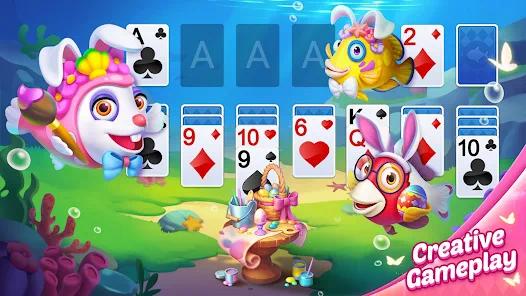






Overview
Solitaire 3D Fish is the unusual hybrid where the bolt-on is the better half. Playdayy wraps a conventional card game in a rendered 3D aquarium you stock, feed and decorate, and our source material is explicit that the aquarium is doing the heavy lifting: the collection layer is there to offset how repetitive a traditional card game becomes on its own. Ten million-plus installs and a 4.6 average across 669,866 ratings suggest the idea lands. The friction is documented just as thoroughly, and nearly all of it is advertising.
The Klondike underneath
Our source material describes a deliberate hybrid: classic Klondike mechanics on one layer, a rendered aquarium simulation on the other, with the collection loop there to keep the cards from going stale. It is worth being precise about the card half, because solitaire is the game everyone assumes they already know the settings for. Our records state that the card component adheres strictly to traditional Klondike, supports both Draw 1 and Draw 3 card settings, offers standard and Vegas cumulative scoring, and keeps standard statistical tracking. The listing FAQ confirms those are player-selectable rather than fixed: you toggle between Draw 1 and Draw 3, and you pick between the standard and Vegas scoring models.
That is the whole of what our records say about the rules, and we stop where they stop rather than fill gaps from assumption. Vegas here is simply the name of the second of the two selectable scoring models our source lists; our material puts no formula behind either one, and we are not going to supply one. If a particular setting is what decides which card app stays on your phone, check the in-app settings screen before committing.
The aquarium is the actual product
The collection layer is where the visible design effort went, and our records are detailed about it. Winning a hand pays out in specialized currencies and stars, and those feed a “Gashapon Machine” — a toy-dispenser mechanism our source records as the primary method for unlocking the fish. The FAQ states the loop plainly: completing solitaire games yields coins and tokens, you spend them at the machine, and it randomly dispenses a new 3D fish. Dozens of species, our source says, with Clownfish, Blue Tangs, Peppermint Angelfish and deep-sea Anglerfish among the named ones. What our records do not put numbers on is how often any particular fish turns up, and we will not guess.
The rendering is a documented strength in its own right, not just set dressing. Our source describes active ocean environments with realistic water dynamics, shifting light shafts and fully animated marine behaviours, and our database’s pros single out the fluid fish animation and water rendering as making the whole thing visually soothing — which is also the note the stored user feedback leads with.
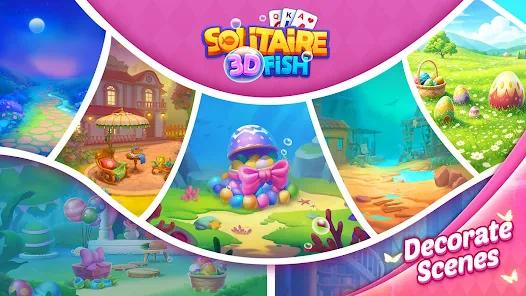
Around that sits a tank you build rather than pick from a menu: our records describe corals, shells, ancient ruins and specialized lighting filters as selectable and positionable, and the FAQ says you have full control to place, rotate and swap them. There is also a feeding system, and this is the one point where our material has the two layers connecting mechanically — interacting with your collected fish directly influences the aquarium’s passive coin-generation rate. Our database files that combination, feeding plus decoration, as a competent virtual pet simulator sitting inside a card game, and on the recorded detail that reads as fair.
The ads, stated plainly
This is the headline caveat. Our source material records unskippable interstitial advertising after virtually every single completed hand, and our database’s cons entry puts a length on it: mandatory 30-second advertisements at the end of nearly every game, disrupting play sessions. It is the sharpest note in our stored user feedback too, where a forced commercial after every individual hand is described as frustrating and out of step with the game’s relaxing qualities. The placement is what gives it weight: it falls at the end of a hand, the moment a card game is supposed to pay off.
A second, lighter layer is worth separating out. The FAQ records that the base daily challenge can be played without ads, but that receiving the associated premium chest rewards or multiplying the daily coin rewards typically requires watching video ads. That is the ordinary opt-in rewarded-ad arrangement, and a fair trade on its own terms — only one of the two ad types is a choice. Whether a paid ad-removal option exists is not something our material records, so we cannot tell you what one would cost or cover, and we are not assuming one in either direction.
The offline route, and what it costs you
The documented workaround is genuinely useful: our records describe an offline mode in which disconnecting from network data lets the core card game run without ads, and our database lists offline card access — playing with no active Wi-Fi or data connection — as an outright strength.
The trade is recorded just as clearly: playing disconnected locks you out of daily events, cloud syncs, and the bonuses our source ties to obtaining rarer fish species. The two halves pull against each other. If you are here for the cards, that is a fine bargain. If you are here for the tank, it is the central tension of the design.
Assists, and costs that climb
Our database lists a generous assist set as a documented strength: a “Magic Wand” booster, auto-complete functions, and unlimited hints, all framed as help for navigating challenging deals. The FAQ records the Magic Wand as the answer to a deal with no logical path to victory, describing it as revealing and pulling helpful hidden cards from the deck to bypass the blockage and secure a win. The hints, for their part, are recorded as unlimited.
The clearer cost pressure sits on the collection. Our database’s cons record that the virtual currency required to unlock late-game decorative assets and rare species rises sharply — an escalating curve rather than a flat price list. Our source states that as a design fact and nothing more, and we are reporting it the same way. What it means in practice is simple enough: the later assets and the rarer fish cost more of the same currency you earn by winning hands, so they take longer to reach.
What the promos show versus what you install
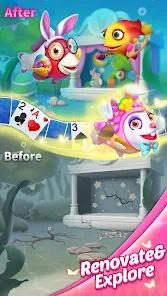
Two parts of our material land on the same point. Our database’s cons record that promotional materials often highlight rescue-themed puzzle mini-games that do not reflect the actual card-playing loop, and a stored user-feedback theme says the same thing from the player side — the advertising shows engaging rescue puzzles, while the app itself is described as mostly standard solitaire with a fish theme. Keep the recorded scope exact: what our material records is that those mini-games do not reflect the card-playing loop you actually get. It is an expectations question to settle before you install rather than something you hit mid-game.
One smaller running cost: our database flags higher battery consumption than a standard 2D card game, which follows from rendering fully animated 3D environments. Budget for it on long sessions away from a charger.
Reception and recency
A 4.6 average across 669,866 ratings is a large sample, and our records show the Play listing updated on March 19, 2026 — active maintenance rather than a title left to drift. The praise in our stored feedback is specific rather than generic: the water rendering and realistic fish movement described as a soothing escape, the feeding mechanics and aquarium customization described as making the collecting feel rewarding.
Who it’s not for
Anyone with a low tolerance for interstitial advertising. Our records document a mandatory video at the end of nearly every game, and the documented way around it — disconnecting — costs you the collection progress that is the point of the app.
Anyone who wants a lean, fast card app. The 3D tank is the reason this exists; if what you want is to deal, play and deal again with minimal ceremony and minimal battery draw, that is not what is being built here.
And anyone who arrived from a rescue-themed puzzle advert expecting that game, for the reason recorded above.
Our take
Solitaire 3D Fish is a well-made version of an idea that suits solitaire unusually well: give the wins somewhere to accumulate. The aquarium is more than a skin — a collectible roster, a tank you arrange yourself, a rendering our source describes in real detail, and a feeding system our records tie to passive earnings — and the card game underneath is a straight, configurable Klondike with a helpful set of assists. On the documented evidence, the 4.6 average looks earned.
We file it as situational rather than a blanket recommendation because of the advertising cadence recorded against it, and because the one documented escape from that cadence works by trading away the half of the game that gives the cards their purpose. If that trade sounds acceptable, this is an easy install with a lot to look at. If it doesn’t, you will meet the friction on your first win.
How We Evaluate
We did not hands-on test this game. We did not install it, play a hand, spend anything at the Gashapon Machine, or run it disconnected. This is a desk assessment, and it rests on our own editorial database entry for Solitaire 3D Fish — the feature set recorded there (Klondike with Draw 1 and Draw 3 card settings, standard and Vegas cumulative scoring, statistical tracking, the "Gashapon Machine" unlock loop, the collectible 3D fish roster, tank decoration and placement, the feeding system, the assist set, and offline play) and the pros and cons recorded alongside it — plus the listing FAQ and recurring themes across published user feedback, which we read as sentiment summaries written up by our team rather than verbatim quotes, and to which we attach no individual star ratings. We also weighed the store signals: a 4.6 average from 669,866 ratings, 10M+ installs, eight screenshots, a Play update dated March 19 2026, and developer Playdayy. Two limits on what follows. First, we describe the Klondike configuration only where our source states it, and leave anything it does not state unstated rather than assuming a default. Second, where our material records a design criticism, we report it at the scope it is written and add nothing to it.
Pros & Cons
High-Fidelity 3D Visuals: The fluid fish animations and realistic water rendering create a visually soothing experience.
Compelling Hybrid Gameplay: Linking card game victories to virtual pet collectibility drives strong user retention.
Helpful Gameplay Assists: Built-in "Magic Wand" boosters, auto-complete functions, and unlimited hints help players navigate challenging deals.
Interactive Pet Mechanics: The feeding system and custom decorations turn the game into a competent virtual pet simulator.
Offline Card Access: Players can run the core card game without active Wi-Fi or data connections, effectively disabling ads.
- ✕
Heavy Post-Game Ad Load: Mandatory 30-second advertisements appear at the end of nearly every game, disrupting play sessions.
- ✕
Exponentially Scaling Costs: The virtual currency required to unlock late-game decorative assets and rare species rises sharply.
- ✕
Misleading Interactive Ads: Promotional materials often highlight rescue-themed puzzle mini-games that do not reflect the actual card-playing loop.
- ✕
High Battery Consumption: Rendering fully animated 3D environments drains device battery faster than standard 2D card games.
Download


FAQs
How do players collect and unlock new fish species for their aquarium?
Completing solitaire games yields coins and tokens that can be spent at the in-game Gashapon Machine, which randomly dispenses new 3D fish.
Does the game support standard Klondike rules variations?
Yes, players can easily toggle between Draw 1 and Draw 3 card settings, as well as select standard or Vegas cumulative scoring models.
Can the aquarium decorations be moved and personalized manually?
Yes, players have full control over their virtual tanks, with the ability to place, rotate, and swap corals, plants, and ruins.
Is it possible to complete the daily challenges without viewing ads?
While the base challenge can be played, receiving the associated premium chest rewards or multiplying the daily coin rewards typically requires watching video ads.
What happens if a card deal has no logical path to victory?
Players can use the "Magic Wand" booster to reveal and pull helpful hidden cards from the deck, bypass the blockage, and secure a win.
Hot Reviews
The beautiful water rendering and realistic fish movements create a genuinely soothing escape that goes far beyond standard card games.
The decision to force a mandatory 30-second video commercial after every individual hand is frustrating and disrupts the game's relaxing qualities.
The interactive feeding mechanics and deep aquarium customization options make collecting the fish feel highly rewarding.
The advertising shows engaging rescue puzzles, but the actual app is mostly standard solitaire with a fish theme.