Solitaire.com - Classic Cards


Overview
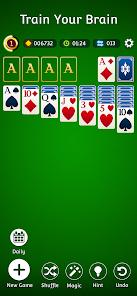
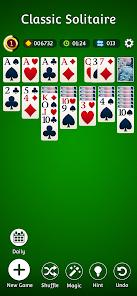
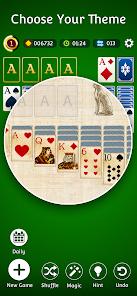
Developed by London-based Tripledot Studios Limited, this application functions as the flagship mobile client for the web-based casual card portal Solitaire.com. The game targets classic Klondike Solitaire players, emphasizing ergonomic gameplay, offline accessibility, and a minimalist aesthetic that the developer describes as "no-fuss Solitaire". It structures the game around the traditional Patience loop: arranging a 52-card deck into four foundation piles sorted by suit in ascending order from Ace to King.
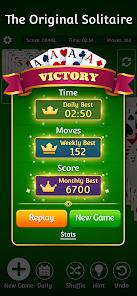
To accommodate varying skill levels, the engine offers two primary draw modes: the highly accessible Draw 1, which serves as a low-pressure entry point, and the strategically complex Draw 3, which restricts access to cards within the stock pile and demands deeper forward planning. The gameplay experience is further diversified by its scoring methodologies. Standard scoring starts players at zero points and rewards tactical execution. Moving a card to the tableau awards 5 points, flipping a face-down card in the tableau grants 5 points, and successfully graduating a card to the foundation piles awards 10 points. Conversely, undoing a move penalizes the player by 2 points, and passing through the stock pile after a set limit incurs point deductions.
For players seeking high-risk engagement, the game incorporates Vegas scoring. This model simulates casino-style wagering by requiring an upfront entry cost of 52 virtual chips. Players must recoup this investment by earning 5 chips for every card successfully moved to the foundation piles. Because Vegas rules prohibit re-dealing or drawing cards beyond standard limitations without steep penalties, it acts as a significant test of card management.
To address the inherent randomness of card shuffles, Tripledot implements a binary deck selection system. Players can opt for "Random Decks," which are generated dynamically using standard random number generator algorithms and do not guarantee a viable path to victory, or choose "Winnable Decks," which are mathematically verified to possess at least one valid solution sequence. This dual approach satisfies both traditionalists who favor raw probability and casual players who prioritize progression and psychological gratification.
However, the application’s monetization framework introduces significant friction into this gameplay loop. Operating under an ad-supported, free-to-play model, the software implements aggressive ad-delivery mechanics. Users report high ad frequencies, with interstitial video ads launching after nearly every game, level-up transition, or screen shift. In 2026, the developer introduced top-of-screen banner advertisements that remain active during live play. This design decision reduces the usable vertical display area, disrupts visual concentration, and increases the probability of accidental clicks, creating tension between short-term monetization and long-term user retention.
Furthermore, the data privacy profile reveals extensive background data tracking. The game shares device IDs, personal information, and performance statistics with third-party advertising networks, raising privacy concerns among security-conscious players. While the option to play entirely offline provides a reliable workaround to disable ad servers, it disconnects users from global leaderboards and progressive cloud syncing features.
Pros & Cons
Provides complete offline playability, allowing users to enjoy games without internet access or data usage.
Includes a mathematically verified "Winnable Decks" mode to ensure every deal has a viable solution.
Implements robust support for Left-Handed Mode, mirroring the layout for improved accessibility.
Features deep visual customization options, enabling changes to card faces, backs, and table felts.
Supports high-risk Vegas scoring models with cumulative score-tracking options.
Offers helpful play features like an intelligent hint system and unlimited undo capabilities.
- ✕
Aggressive ad-delivery mechanics run unskippable interstitial videos after nearly every completed game or menu transition.
- ✕
Active top-of-screen banner ads run during gameplay, increasing the risk of accidental clicks.
- ✕
Shares extensive device diagnostics and personal identifiers with third-party marketing networks.
Download


FAQs
Is com.tripledot.solitaire entirely free to play?
Yes, the application is 100% free to download and play, supported by third-party advertising.
How do players switch between Draw 1 and Draw 3 card modes?
Users can toggle the deal settings by navigating to the Settings menu and selecting the "Deal three cards" option.
Can the game be played without an active internet connection?
Yes, the game fully supports offline play, which also bypasses third-party advertisements.
What is the difference between standard and Vegas scoring?
Standard scoring awards points based on positive card placement and movement, while Vegas scoring requires a 52-point buy-in and awards 5 points per card moved to the foundations.
How are the appearance of cards and the background customized?
Open the Settings menu and choose either "Card design" or "Table design" to select from a variety of visual themes.
Hot Reviews
The frequency of advertisements is highly disruptive. Interstitials trigger after almost every game, level-up, or menu change, and persistent top-of-screen banner ads during gameplay cause accidental clicks that redirect players out of the app.
The presence of unlimited hints, undos, and the ability to reshuffle cards when stuck provides a highly accommodating environment for casual players wanting to complete challenging boards.
The game runs smoothly and reliably in airplane mode, making it an excellent travel game for users who want to avoid high ad loads and data consumption.