500 Rummy ZingPlay






Overview
Developed by VNG ZingPlay Studio, 500 Rummy is a competitive online multiplayer adaptation of Rummy 500. Often referred to as 500 Rum, Persian Rummy, or Pinochle Rummy, this variant differs significantly from standard rummy and gin rummy by allowing players to draw multiple cards from deep within the discard pile. This mechanic demands deep attention and card tracking, as any card drawn must be played immediately in a valid meld.
The game is played with a standard 52-card deck plus a single wild Joker. Each player is dealt a starting hand (13 cards in a two-player matchup, or 7 cards in larger groups). On their turn, players can draw from the stockpile or grab cards from the discard pile. Players score positive points by forming sets (three or four of a kind) or runs (three or more consecutive cards of the same suit) and laying them on the table. They can also lay off cards onto existing melds—including those of their opponents.
Scoring is calculated across consecutive rounds until a player reaches the 500-point threshold. Cards laid in melds award positive points: numbered cards (2-10) are worth face value, royal face cards are worth 10 points, and Aces are worth 15 points. Crucially, any unmelded cards left in a player’s hand when the round ends are deducted as negative points, making hand-management highly strategic.
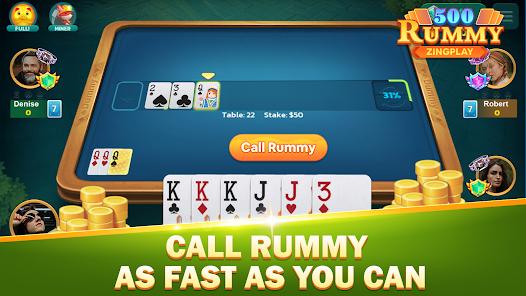
VNG ZingPlay Studio pairs this rule set with highly polished presentation, including high-definition graphics, smooth card animations, and interactive elements like chat and custom emotes. The app also features a global matchmaking pool, progressive multiplayer leagues, and custom tables with variable entry fees.
Despite its strong presentation, the game's economic model introduces clear player friction. Utilizing a free-to-play system with chips and virtual gold, the game funnel encourages high-stakes tables. This can make progression difficult, as a single bad hand or disconnection can completely wipe out a player's chip balance and encourage microtransactions. Additionally, the lack of end-to-end encryption for transmitted user data raises minor privacy concerns.
Pros & Cons
Real-time competitive multiplayer matches that pair players with real opponents globally.
High-definition visual assets and smooth card movement designed for premium mobile viewing.
Generous initial login bonuses and daily coin support to encourage continuous play.
Structured seasonal league progression that rewards tactical mastery and ranking advancement.
Detailed personal matchmaking statistics to track performance and win rates over time.
Responsive layout that performs smoothly during intense, multi-card draw turns.
- ✕
Aggressive coin-sink progression gating pushes players toward microtransactions.
- ✕
High volume of post-round video advertisements disrupts multiplayer flow.
- ✕
Connection drops can cause immediate player bankruptcy due to automated losses.
Download
 Get it on Google Play
  Get it on App Store
 FAQs
How does multi-card drawing work in Rummy 500?
Players can draw multiple cards from the discard pile, but the deepest card drawn must be used immediately in a valid meld.
How are Aces and Jokers scored?
Aces scored in melds are worth 15 points, while Jokers are wild cards that match the point value of the card they replace.
Does the application support private tables?
Yes, players can create private rooms, set custom stakes, and invite friends to play.
Can Rummy 500 be played completely offline?
Yes, while competitive leagues require a network connection, the app includes offline practice modes against AI.
Is player data encrypted during online matches?
The developer's privacy telemetry indicates that online data transmissions are not fully encrypted.
Hot Reviews
The visual presentation is top-tier for a rummy app. The multiplayer matches run smoothly, and the interactive emotes and chat tools make tables feel social and engaging.
The volume of ads is frustrating. Having to sit through unskippable video ads after every single hand disrupts the competitive flow of multiplayer games.
The chip-based economy can be punishing. The game tends to push players toward high-limit rooms where a single loss or connection issue can bankrupt their balance, leaving them unable to play without buying chips.