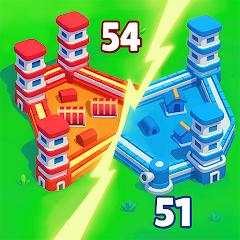
Tower War - Tactical Conquest
A smarter-than-it-looks strategy game whose single-swipe, tower-to-tower troop-flow loop is genuinely satisfying and fully playable free and offline in short bursts. Two things are worth knowing first: the premium tier is expensive — 'legendary' units can run as high as around $100 and a VIP subscription near $30 a month — and a widely reported difficulty step around Level 15 leads many players to describe the later stages as pay-to-win, something the game's own FAQ partly concedes by noting free progression slows sharply without purchases or ads.
- Players who like quick, thinky strategy in under-three-minute bursts — the single-swipe troop-flow loop rewards timing and board-reading, and the campaign runs offline for commutes and flights
- Anyone content to enjoy it as a free game and ignore the premium store — the early and middle levels are the strongest part of the package and cost nothing
- Completionists and competitive players who want to reach the top tiers without heavy grinding or spending — the game's own FAQ concedes free progression slows sharply after around Level 15
- Anyone put off by high-priced optional purchases — the 'legendary' units reaching around $100 and a roughly $30-a-month VIP subscription sit well above the norm for a casual title, even though they're entirely skippable
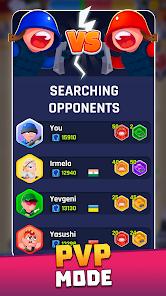

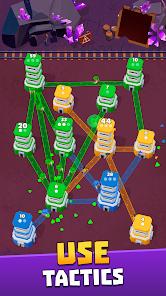



Overview
Tower War - Tactical Conquest is the rare hyper-casual game that made us stop and actually think about a swipe. Under a toy-simple surface — you drag your finger from one tower to another to send troops — sits a real strategy problem about where to commit your numbers and when, and that is why this SayGames title has passed 100 million downloads since its June 2021 debut. It also carries a monetization story worth hearing up front, because the gap between how it plays for free and how its top tier is priced is unusually wide. This review is mostly about holding those two in balance: a genuinely clever core loop attached to a spending model aimed at a small number of high-investment players.
What it actually is
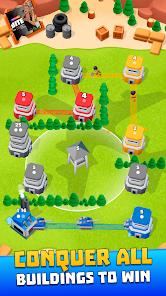
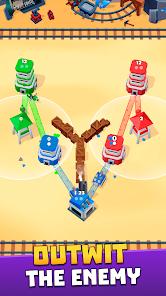
Strip the “tactical conquest” label back and the mechanic is elegant. The board is a set of interconnected towers — some yours, some the enemy’s, some neutral. Each generates troops of its own; you redirect them with a single swipe from one tower to another, and whoever arrives with the larger number takes or holds the target. Every captured tower becomes its own production hub, so the game is really about compounding: grab the right neutral towers early, build a numerical advantage, and push before the enemy does the same to you. This is not classic tower defense, where you plant static turrets and watch waves break against them — here nothing sits still. You are constantly rebalancing a live front, and a lead can evaporate in two or three careless swipes. That distinction is the whole appeal.
Why the core loop works
What makes it moreish is the session length. A level resolves in under three minutes: a full strategic arc — opening, expansion, decisive push — that fits into the time you spend waiting for a coffee. The single-swipe control is the other half of it. Redirecting troops takes one gesture, so you can manage several fronts at once without fighting the interface, and the high-contrast “gray stylistics” art — that deliberately desaturated military look — keeps tower ownership and troop movement legible even when hundreds of units are in motion. The result is the “one more level” pull the most positive reviews single out, where the urge to replay a board with a smarter opening is what keeps you there.
The difficulty curve and unit types
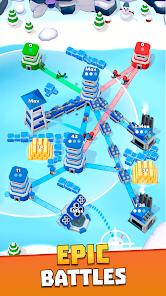
Early boards are a gentle math-check: send more troops than the other side, win the tower. The game keeps that from going stale by layering in complications as you climb. Blockades and landmines start shaping the terrain, so the shortest path between two towers is not always the safe one, and the plain unit-count calculation gives way to something closer to timing and routing. The roster widens too: infantry are your standard capturing troops, tank factories produce high-durability units that push through defended positions, and artillery posts add long-range softening before an assault — which, per the game’s own description, opens more than one path to a win. This is the strongest stretch of the game, where it stops being a numbers game and becomes a small tactics puzzle. One friction is worth flagging from user feedback: the control that sells or downgrades a defensive tower reportedly sits close enough to normal inputs to be triggered by accident, which stings on a tight level.
The Clan and social layer
At a certain level milestone the game unlocks Clans, its social layer: join or create a group, contribute to group objectives, and appear on global leaderboards. This is clearly SayGames trying to turn a solitary time-killer into something with a reason to return daily, and the campaign itself stays playable offline — only the Clan and daily-update features need a connection. Whether it lands for you is a matter of taste: for some, a swipe strategy game is a solo commute activity and the leaderboards are noise; for others the group objectives are what keep the app installed. It reads as an addition, not an imposition.
The monetization reality
Here is the part a prospective player most needs to hear. Tower War is free to download and play through, but its spending model centers on a small number of high-value purchases, and the ceiling is high. “Legendary” characters can cost as much as around $100 each, and a VIP subscription runs at roughly $30 a month — figures well above what casual mobile games usually ask. There are also optional rewarded ads: you are not force-fed interstitials, but the game offers ad-supported boosters, surfacing them when you are most likely to be stuck. None of this is hidden, and a patient player can progress without spending. Our criticism is narrower: for a casual audience, the value of a roughly $100 unit or a $30 monthly subscription is hard to justify against what the free game already delivers, and that mismatch — a breezy, accessible front end attached to a premium tier priced for committed spenders — is the central tension of the package.
The Level 15 complaints
The most-repeated criticism in published feedback clusters around a difficulty step that many players place around Level 15. The recurring account is that the game gets sharply harder there — reviewers describe the AI leaning on powerful items, and some mention enemy napalm at a frequency they found unfair — to the point that several call the later stages “pay-to-win.” We want to attribute this precisely rather than adopt it as our own flat finding. What we can state as fact is narrower: the game’s own FAQ concedes that difficulty scaling after Level 15 makes free progression “extremely slow” without either buying upgrades or watching multiple ads. So the honest read is not that the game is provably rigged — that is a player perception we cannot verify — but that a real, widely reported difficulty wall exists at roughly that point, that the developer acknowledges progression slows there, and that many players experience the combination as pressure to spend. If you are the sort to hit that wall and feel nudged toward your wallet, that is worth knowing going in.
How it compares
Placed against the wider hyper-casual and .io-style strategy field, Tower War’s edge is the quality of its core mechanic. Most one-swipe games give you a single action and a single goal; this one builds a compounding, multi-front strategy problem out of the same minimal input — a better idea than most of its shelf-mates manage. Its monetization, by contrast, is middle-of-the-pack: optional-but-expensive premium tiers and spending-friendly difficulty curves are common across the free strategy genre, not unique to this title. So the fair axis to judge it on is not whether it monetizes — nearly all of them do — but how good the free game is on its own terms, and here it is better than most, provided you stay in its free lane.
A word on recency
This is a live, well-maintained game, not an abandoned one. Google Play lists it as updated April 6, 2026, with a 4.2 average across roughly 624,727 ratings, more than 100 million installs, and seven screenshots from developer SayGames Ltd. A 4.2 is solid-not-stellar, but sustained across more than 600,000 votes it tells you something real: a very large number keep playing and rating it well, grumbles and all. That pattern — huge reach, a good rating, a vocal seam of pricing complaints threading otherwise positive feedback — is what you would expect when a game’s core is genuinely liked and its spending model divisive.
Who it’s not for
Go in eyes-open, or look elsewhere, if you are a completionist who needs to reach the top of the ladder without grinding or paying — the FAQ’s own admission about post-Level-15 progression means that path is slow by design. It is also a poor fit for anyone who finds optional-but-prominent premium pricing off-putting; you can ignore the roughly $100 units and the VIP tier entirely, but some players would rather not be asked. And if you want a long-session strategy game with depth measured in hours, the sub-three-minute levels are built for the opposite — small bites, not long meals.
Our take
Tower War - Tactical Conquest earns the “strategy” in its name more honestly than most hyper-casual games earn theirs. The troop-flow loop is clever, the sessions are perfectly sized, and for a free, offline time-killer the early game is genuinely good. We land at “situational” rather than a straight recommendation for one reason: the spending model. The free game is worth your time; the premium tier — legendary units as high as around $100, VIP near $30 a month — is priced for a committed few, and the widely reported difficulty step around Level 15 means the moment you notice that pricing is also the moment the game gets harder. Treat it as a free game for short bursts and ignore the store, and it is an easy install. Expect to reach the top tiers without serious grinding or spending, though, and the FAQ itself hints you will be waiting a while.
How We Evaluate
We did not hands-on test Tower War - Tactical Conquest. This review is grounded in the game's own Google Play listing and description, its stated features (the tower-to-tower troop-flow mechanic, single-swipe redirection, the sub-three-minute offline campaign, blockades and mines, tank-factory and artillery unit types, and the Clan social layer), its FAQ, and its store signals — a 4.2 rating across roughly 624,727 ratings with 100M+ installs and 7 screenshots, updated April 6, 2026, from developer SayGames Ltd — together with the recurring themes in published user reviews and our own database's pros and cons. Where we cite user sentiment — the pricing objections and the widely reported difficulty step around Level 15 — we are reflecting documented recurring feedback rather than personal play sessions. One point we treat as fact rather than sentiment: the game's own FAQ concedes that progression slows sharply after Level 15 without purchases or ads.
Pros & Cons
Refined Control Interface: The single-swipe mechanic allows for instantaneous tactical redirection, which is essential for managing multiple fronts simultaneously.
Optimized Session Design: Level lengths are specifically engineered for mobile use, providing a full strategic loop in under three minutes.
Visual Clarity: The stylized, high-contrast art ensures that unit movements and tower ownership are identifiable at a glance, reducing cognitive load.
Robust Offline Play: The core single-player campaign does not require a persistent internet connection, making it highly versatile for travel.
Dynamic Obstacle Integration: Features like landmines and terrain-shaping mechanics prevent the gameplay from becoming a simple "math-check" of unit counts.
Community Expansion: The Clan system facilitates long-term engagement through social interaction and group-based objectives.
Strategic Variety: The inclusion of tank factories and artillery units diversifies the combat, allowing for multiple viable paths to victory.
- ✕
Steep In-App Purchase Costs: The pricing of premium assets and monthly VIP subscriptions is significantly higher than industry averages for casual titles.
- ✕
Artificial Progression Hurdles: Users report that the game appears "rigged" after Level 15, forcing either extreme grinding or monetary investment to succeed.
- ✕
Repetitive Ad Integration: While ads are optional for rewards, the game frequently prompts for ad-supported boosters to overcome sudden difficulty spikes.
- ✕
Input Sensitivity Issues: The "sell" mechanic for defense towers is prone to accidental activation, which can be devastating in high-stakes levels.
Download


FAQs
Is Tower War - Tactical Conquest suitable for children?
The application is rated 3+ by PEGI and "Everyone" by the ESRB. The violence is abstract and bloodless, focusing on strategic unit movement rather than graphic combat, making it appropriate for a broad age range.
Does the game require a persistent internet connection?
While social features like the Clan system and daily updates require connectivity, the main campaign levels are designed to be played offline, ensuring accessibility in low-connectivity environments.
How do I join a Clan within the game?
The Clan feature is unlocked after reaching a specific level milestone. Once available, players can search for existing groups or create their own to compete in global leaderboards and social challenges.
Are the in-app purchases necessary to finish the game?
Theoretically, the game can be completed for free; however, many users report that the difficulty scaling after Level 15 makes progression extremely slow without purchasing upgrades or viewing multiple ads.
What are the primary differences between unit types?
Infantry are standard units for capturing towers, whereas tank factories produce high-durability units and artillery provides long-range support to soften enemy defenses before an assault.
Hot Reviews
The game is frequently praised for its "one-more-level" appeal. Users find the timing required for troop movements to be genuinely sophisticated, noting that it rewards players who can calculate unit flows under pressure while maintaining an easy-to-learn interface.
A significant number of long-term players have expressed frustration with the cost of legendary units. Some reviewers have called the $100 price tags "ridiculous," arguing that the game transitions from a casual experience to a "pay-to-win" model in later stages.
Feedback often highlights a shift in AI behavior around Level 15. Users have reported that the enemy begins using powerful items like napalm at a frequency that feels unfair, often requiring the player to watch multiple ads just to remain competitive.