
State.io — Conquer the World
Overview
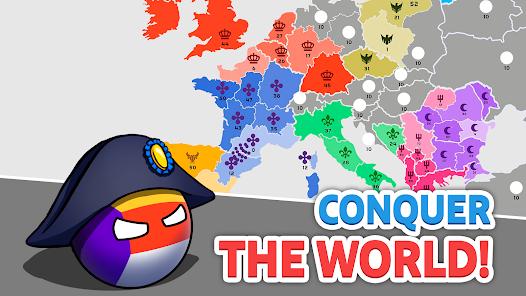
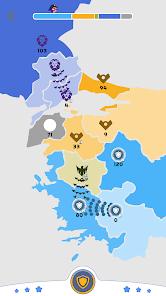
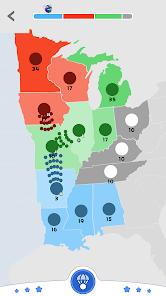
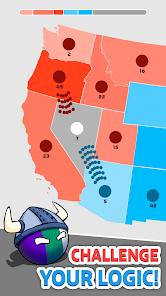
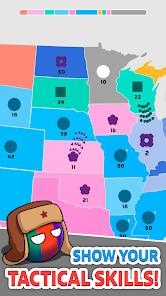
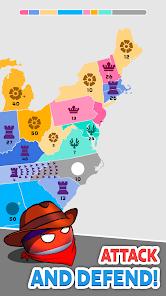
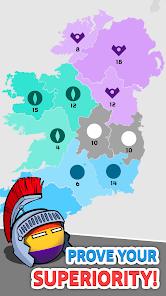
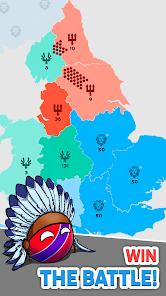
State.io - Conquer the World, represents a significant structural evolution within the hyper-casual strategy market. Developed by Casual Azur Games, this title marks a departure from the simple survival mechanics of early "io" games, such as Agar.io, by integrating abstract real-time strategy (RTS) and spatial logic puzzles. The core gameplay mechanism revolves around a "cell conquest" system, where players manage numerical unit counts within discrete nodes (representing countries or territories) and deploy them to overwhelm adjacent enemy nodes. This minimalist approach reduces the cognitive overhead associated with traditional 4X strategy games while retaining the fundamental tension of resource allocation and border defense.
Technical observation of the game’s architecture reveals a heavy reliance on fluid, vector-based animations that allow for high-performance rendering of hundreds of moving "dots" or units simultaneously. This efficiency ensures that the game remains accessible on low-tier hardware, a critical factor for achieving its 100M+ download milestone. The game’s "Warpath" logic utilizes adaptive AI that focuses on territory takeover rather than simple attrition, forcing the player to act as a macro-level strategist rather than a micro-manager. Unlike more complex titles where unit types vary in capability, the units in State.io are functionally identical; the complexity arises entirely from the spatial arrangement of the nodes and the timing of the player's maneuvers.
In-depth comparison with historical peers suggests that State.io has successfully commoditized the "territory painting" mechanic. It focuses on numerical flow. This abstraction allows for the inclusion of varied thematic environments, including multi-planetary stages like Earth, Mars, and Jupiter, each offering unique node densities and connection paths that alter the mathematical optimal path to victory. Furthermore, the game serves as a bridge for players transitioning from casual puzzles to more demanding strategy titles, providing a "zen-like" experience of global conquest that is periodically interrupted by the friction of a highly aggressive ad-monetization framework.
Insightful observations regarding the game’s trajectory in 2026 suggest a pivot toward forced connectivity. While earlier versions allowed for significant offline play, current iterations often require an active internet connection to facilitate real-time ad delivery and server-side validation of in-app purchases. This shift reflects a broader industry trend where "free-to-play" labels are increasingly tied to high-frequency ad-interstitials, with some users reporting ads after every single level completed. Despite this, the game's core logic—solving tactical dot puzzles—remains a pure and satisfying expression of spatial strategy.
Pros & Cons
Minimalist visual design provides clarity during complex multi-front wars and ensures compatibility with older mobile devices.
Abstracted unit management allows players to focus on high-level strategic decisions rather than repetitive micro-management.
Diverse map layouts and thematic planetary levels provide a sense of progression and prevent the core loop from becoming stagnant.
One-handed controls and short level durations make it an ideal "snackable" game for commuters and casual users.
The logic-based gameplay offers a more cerebral experience than typical hyper-casual clickers, encouraging long-term mental engagement.
Regular content updates continue to introduce new shapes, colors, and territories to the conquest library.
- ✕
High frequency of unskippable advertisements significantly disrupts the tactical flow and user immersion.
- ✕
AI difficulty scaling can be inconsistent, with some users reporting that the computers do not get harder, only numerically advantaged.
- ✕
The transition to an internet-mandatory connection limits the game's accessibility in low-connectivity environments.
Download


FAQs
How do you win a match in State.io?
To win, you must capture all nodes on the map by deploying your units until your color occupies every territory.
Is State.io a multiplayer game?
While the interface suggests competing against others, the majority of the gameplay is against sophisticated AI bots designed to mimic player behavior.
Can I play on different planets?
Yes, the game features levels set on Earth, Mars, Venus, and Jupiter, each with different layouts.
Why does the game require an internet connection?
Connection is typically required to load ads that keep the game free-to-play and to sync in-game purchases.
What are the dots representing?
The dots represent your military units or "power" within a specific territory; higher numbers indicate stronger nodes.
Hot Reviews
The strategic core of this game is brilliant and addictive, but the user experience is hampered by the fact that you are forced to watch a thirty-second ad after every single minute of gameplay.
It is rare to find a game that distills real-time strategy down to its purest form. State.io manages to make global conquest feel like a relaxing puzzle while still requiring genuine tactical thought.
While the game is fun, the computer players don't actually get "smarter" as you progress; they simply start with more territory or units, which feels like an artificial way to increase difficulty.