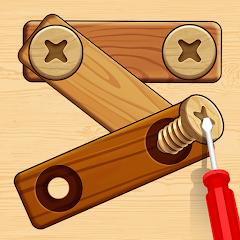
Wood Screw Puzzle
The premise is doing real work here: our records describe a physics puzzle where the order you remove screws in decides whether the board resolves or jams, and the strengths filed alongside it — over 1,000 levels, offline play, and sound design users single out — are substantial. What to weigh against that is the friction our records log around it: long advertisements between levels in our stored feedback, a 3-minute timer on daily challenges and hard stages, and extra screw holes that cost coins or a video ad.
- Players who want mechanical logic rather than colour or shape matching — our source material describes unscrewing fasteners from multi-layered wooden plates, iron sheets and structural bars and dropping them into vacant threaded holes until the board is clear
- Anyone who enjoys planning several moves ahead: our records state plates swing around their remaining pivot points as screws come out, so move order decides whether a level resolves
- Players who need a puzzle that works without a connection — our database files fully functional offline support as a strength, and the listing FAQ puts the core mechanical levels and physics puzzles offline
- People who play partly for the sound: ASMR mechanical clicks and wood clacking are recorded in our source material and echoed in our stored user feedback
- Players who want a long catalogue — our database's pros record over 1,000 levels, and a recurring feedback theme credits combinations of wood, iron and brass plates for keeping it varied
- Competitive solvers: a global leaderboard is filed among the recorded strengths, framed around improving solving times
- Anyone who wants no clock anywhere — our database's cons file a 3-minute timer on specific levels as stressful for a casual puzzle, and the listing FAQ places it on daily challenges and hard-difficulty stages
- Players with a low tolerance for advertising between levels — a recurring theme in our stored feedback describes the frequency of long advertisements between levels as disruptive to game flow
- Anyone who would find losing a solved-in-progress board irritating: our records note planks can occasionally swing into positions that block open holes, requiring a level restart
- Players who want board assists kept out of a coin-and-ad economy — the listing FAQ states extra empty screw holes are unlocked by spending coins earned through gameplay or by watching a short video ad
- Anyone who needs the cost picture confirmed before installing — our material carries no prices at all, which is a gap in our data rather than a statement about the app


Overview
Wood Screw Puzzle is a strong pick if physical logic is the kind of puzzle you like, and the reason is the mechanic itself, which our source material is specific about. It describes multi-layered wooden plates, iron sheets and structural bars fastened together by screws, nuts and bolts, and a single job: unscrew the fasteners one at a time, drop each into a vacant threaded hole elsewhere on the board, and keep going until every structural plate has fallen away and the board is clear. What makes that more than busywork is recorded right alongside it: the plates have weight, and they move when you take their fixings out.
The mechanic, as our records describe it
Our own database entry frames this as a shift away from colour and shape matching toward physical and mechanical logic, and the detail it gives supports the framing. Screws are not simply deleted when you remove them; they have to go somewhere, and the somewhere is a vacant threaded hole. That turns the board into a resource problem as much as a sequencing one — the empty holes are the currency behind every move.
Our records single out the physics simulation as the standout feature. Planks and plates react dynamically to weight, balance and gravity, and as screws come out, whatever remains of a plate’s attachment becomes a pivot point it swings around. Our database files that simulation as its first recorded strength — a realistic and satisfying mechanical experience — and a theme in our stored user feedback lands in the same place, describing watching planks react to gravity as what makes the solve satisfying.
Where the difficulty actually sits
The interesting consequence, and our source states it plainly, is that move order is load-bearing. An incorrect sequence can cause plates to fall and block open screw holes — and our records go as far as saying that can make a level impossible to complete.
That is our records’ phrasing, and it has to be read next to what the listing FAQ records for exactly that situation: if a falling plate blocks a hole, you restart the level, use an “Undo” action, or use a tool booster to clear the blockage. Taken together, the recorded picture is a board you can move into a dead end, not a level you are stuck on permanently. That is also why our source describes the game as requiring players to plan several steps ahead visually. It is a planning game, and the failure state is one you set up for yourself several moves earlier.
When the board jams
The same property produces the sharpest recorded complaint. Our database’s cons state that planks can occasionally swing into positions that block open holes, requiring a level restart. That is the design working as described and being frustrating at the same time — a physics system faithful enough to trap you.
Note the difference in pitch between our own two entries: the cons put the cost of a jam at a level restart, the description reaches for “impossible to complete”. The FAQ’s remedies sit closer to the cons, so that is the version we weight. Past their names, though, our material is thin: Undo is recorded as an action and nothing further, and nothing in our records says how a tool booster is obtained — we are not going to fill that in.
Timers, and where they actually land
Our database’s cons file a 3-minute timer on specific levels as something that can feel overly stressful for a casual puzzle game, and a theme in our stored user feedback says the same from the player side: strict timers on specific levels feel too frantic for what is otherwise, in that same feedback, a wonderful set of physics puzzles.
The listing FAQ narrows the scope, and the narrowing matters. It states that most standard levels are untimed, to allow relaxed and thoughtful planning, and puts the 3-minute clock on specific daily challenges and hard-difficulty stages. So the recorded picture is not a game that times you by default; it is a game whose optional and hardest content does. If you never open a daily challenge, our material gives no reason to expect a countdown in ordinary progression — though “hard-difficulty stages” sits inside progression rather than beside it, and our records do not say how much of the catalogue that covers.
Coins, video ads, and what money does here
Here is the monetization exactly at the scope our records give it, and no wider. Coins are earned through gameplay. The listing FAQ says extra empty screw holes on a board can be unlocked by spending those coins or by watching a short video ad. It also says coins earned in-game unlock woodworking backgrounds and tool skins — the cosmetic layer our source material describes as unique wood grains, polished metal finishes and custom tool skins.
Two things follow. First, the assist our records name most clearly — more places to put screws — has two routes recorded for it, coins earned by playing or a short video ad, and neither is priced in our material. Second, our database’s cons record that the steep difficulty curve on later levels can make the gameplay feel ad-heavy to unlock “necessary board features”. That is our records’ wording and our records’ claim, at the scope they state it; we report it, we do not adopt it, and we add nothing to it.
Separately, a recurring theme in our stored feedback describes the frequency of long advertisements between levels as disruptive to game flow, in the same breath as calling the mechanical gameplay top-tier. Our material records no ad lengths, no counts and no prices, and we timed nothing ourselves, so that theme is where our knowledge of the ad load starts and stops.
What else is in the box
Our database’s pros run long, and they are substantive rather than decorative. Over 1,000 levels is recorded as a strength, and one of the four feedback themes agrees from the other direction, crediting combinations of wood, iron and brass plates for keeping levels varied rather than repetitive. (Brass appears only in that feedback theme; our source description names wooden plates, iron sheets and structural bars.)
Fully functional offline support is filed as a strength, and the listing FAQ puts the recorded scope at the core mechanical levels and physics puzzles. That is where our material stops, and so do we. A global leaderboard is recorded as a strength, framed around motivating players to improve their solving times. Presentation gets two entries of its own: high-contrast wood textures and clean visuals described as easy on the eyes, and the ASMR sound design — mechanical clicks and wood clacking — which our source describes as making the game feel tactile and our stored feedback picks out as crisp.
Reception, recency, and a note on our own data
A 4.6 average across 1,057,614 ratings is a large sample sitting high, and our records list 50M+ downloads, eight screenshots and a Play listing updated on February 11, 2026 — recent maintenance rather than an abandoned title.
One caveat about our own material: our records list the developer as “iKame Games - Zego Studio” while our description credits “Zego Studio” — overlapping rather than conflicting names, though our data cannot tell us which is the operating entity. And the stored feedback we have drawn on above, we treat as sentiment summaries written up by our team rather than verbatim user reviews, which is why we take themes from it and never a score.
Who it’s not for
Players who want a puzzle with no clock anywhere: the 3-minute timer is confined by our FAQ to daily challenges and hard-difficulty stages, but it exists. Anyone with a low tolerance for advertising between levels, given the recorded feedback theme. Players who would find losing a part-solved board to a swinging plank genuinely irritating, since our cons record that as a restart-level event. And anyone who wants the paid picture settled before installing, because our material contains no prices at all.
Our take
We land at 4.3, just under the 4.6 store average, and the gap is narrow on purpose. Six recorded strengths against three recorded weaknesses is a good ratio, and the strengths are the structural kind: a mechanic with real logic in it, a catalogue our records put above 1,000 levels, offline play, and presentation praised in both our database and our stored feedback. What holds the number slightly back is that two of the three recorded weaknesses are about the friction around the puzzle rather than the puzzle itself — the timer on the harder tier, and the difficulty-curve complaint our cons file against later levels — while the third, the swinging plank that blocks a hole, costs you a level rather than a moment.
We file it as recommended because the default experience our records describe — untimed, offline-capable, driven by a physics system players single out as the best thing here — is the one most people will actually play, and the caveats are ones you can see coming before you install.
How We Evaluate
We did not hands-on test this game. We did not install it, solve a level, time an advertisement, spend a coin or trigger a booster. This is a desk assessment, and it rests on our own editorial database entry for Wood Screw Puzzle: the mechanics recorded there (the plates, sheets and bars, the screws and the vacant threaded holes they move into, the pivot-point physics and the blocked-hole failure state), the pros and cons filed alongside it, the listing FAQ, and the recurring themes across stored user feedback — which we read as sentiment summaries written up by our team rather than verbatim quotes, and to which we attach no individual star ratings. We also weighed the store signals: a 4.6 average from 1,057,614 ratings, 50M+ downloads, eight screenshots, a Play listing updated February 11, 2026, and a developer recorded as iKame Games - Zego Studio. Three limits on what follows. First, we describe board rules, level structure and assist systems only where our source states them, and leave anything unstated rather than filling it with a genre default. Second, where our material records a monetization criticism, we report it at the scope it is written, attributed to the source, and add nothing to it. Third, where two parts of our material sit awkwardly together, we say so rather than quietly choosing the tidier version.
Pros & Cons
Polished physics simulation creates a highly realistic and satisfying mechanical experience.
Tactile ASMR sound design makes every twist and click of the screws feel incredibly immersive.
Over 1,000 levels provide a deep and continuously challenging puzzle experience.
High-contrast wood textures and clean visuals ensure the game is easy on the eyes.
Fully functional offline support lets players enjoy the puzzle-solving action without an active network connection.
The global leaderboard adds a fun, competitive touch, motivating players to improve their solving times.
- ✕
The inclusion of a 3-minute timer on specific levels can sometimes feel overly stressful for a casual puzzle game.
- ✕
Planks can occasionally swing into positions that block open holes, requiring a level restart.
- ✕
The steep difficulty curve on later levels can make the gameplay feel ad-heavy to unlock necessary board features.
Download
 Get it on Google Play
  Get it on App Store
 FAQs
What happens if a falling plate blocks a screw hole?
If a falling plate blocks a hole, you will need to restart the level, use an "Undo" action, or use a tool booster to clear the blockage.
Are all levels timed?
Most standard levels are untimed to allow for relaxed, thoughtful planning. However, specific daily challenges and hard-difficulty stages feature a 3-minute timer.
How can I unlock more empty screw holes on a level?
You can unlock extra holes on a board by spending coins earned through gameplay or by watching a short video ad.
Does the game support custom styles?
Yes, players can use coins earned in-game to unlock a variety of woodworking backgrounds and tool skins.
Is it possible to play without an internet connection?
Yes, the core mechanical levels and physics puzzles are fully functional offline.
Hot Reviews
The mechanical simulation is fantastic. Watching the planks react to gravity and hearing the crisp woodworking sound effects makes solving these puzzles highly satisfying.
The physics puzzles are wonderful, but the addition of strict timers on specific levels can feel a bit too frantic and stressful.
With a massive selection of levels featuring unique combinations of wood, iron, and brass plates, the gameplay remains consistently engaging and never feels repetitive.
The mechanical gameplay is top-tier, but the frequency of long advertisements between levels can disrupt the overall game flow.