
Quran Majeed – القران الكريم
Quran Majeed is less a scripture reader than a full daily dashboard, and its Hifz memorization audio engine — verse and chapter looping, adjustable recitation speed, configurable pauses to repeat aloud, and a built-in voice recorder — is the most thoroughly engineered part of the package. The honest catches are monetization and polish: the free tier is ad-supported with documented complaints about ad frequency and targeting, Premium in-app purchases range up to $99.99 for a full multi-device license pack, and users report athan alerts that can override silent mode alongside a prayer-time widget that sometimes lags or shows negative countdowns.
- Students of Hifz who want a genuine practice loop rather than a play button — verse and chapter looping, adjustable playback speed, configurable pauses between verses, custom playlists, and a voice recorder for comparing their own recitation against the reference
- People who would rather have reading, audio, prayer schedules, Qibla, a Zakat tracker, and a masjid/halal locator in one install than juggle four separate apps — and who want the core text and translations to work with no connection at all
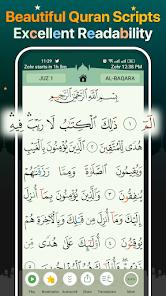
- Readers who want script choice (Uthmanic, Mushaf, Indo-Pak) plus translations and a classical tafsir layer inside the same app, with pinch-to-zoom sizing on a phone screen
- Anyone who wants a lean, single-purpose reader — this is a dashboard, with the notification, permission, and settings surface that implies
- Anyone with low ad tolerance who does not intend to pay: the free tier is ad-supported, with documented feedback about frequent and occasionally poorly targeted ads, and offline audio downloads sit behind the Premium upgrade
- Anyone who keeps a phone strictly silent in meetings, clinical settings, or overnight and would enable athan alerts — until the reported volume-override behavior is resolved — and anyone on an older handset with weak or uncalibrated sensors, given the widget lag reports and the compass's sensor dependency






Overview
The most consequential decision here isn’t in the reading view
What makes Quran Majeed worth a serious look is that it declines to be only a reader. Pakdata has built a daily dashboard — text at the center, and around it prayer schedules, Qibla, Zakat, a locator, and a memorization audio engine that reads as the most thoroughly engineered thing in the package. That breadth explains its 4.7 across roughly 1.04 million ratings better than any single feature could — and most of the rough edges too. We land at 4.3; the gap is ads, a $99.99 ceiling, and three documented bugs.
One thing up front, because it defines our lane: we review software — features, reliability, usability, value — not scripture or anyone’s practice, and we can’t verify scriptural accuracy.
Three scripts, translations, and the reference layer
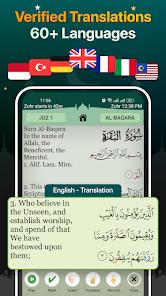
The reading side ships the complete text in three classic scripts: Uthmanic, Mushaf, and Indo-Pak. That matters more than a settings toggle usually does, because readers arrive already used to a particular letterform, and an app that ships only one shape makes everyone else adapt to it. Translations render alongside the Arabic with pinch-to-zoom sizing — the right call on a phone, where fixed type punishes long lines and diacritics. A classical tafsir layer sits above that, with Tafsir Ibn Kathir, Jalalayn, and Saadi named in the listing; we note their inclusion as reference breadth and take no position on their relative authority.
On certification: the listing and the developer’s FAQ both state that all three scripts were proofread and certified by a recognized Muslim Islamic scholar (Alim). We report that as the developer’s stated assurance: we can’t audit textual accuracy or verify a certification, and we neither vouch for the claim nor cast doubt on it. We pass it along in exactly the terms the developer uses; it sits outside what a software review can check in either direction.
The Hifz engine is the standout
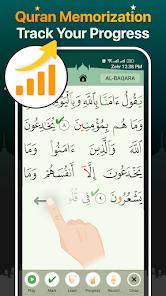
If we had to name one reason to choose this over a simpler reader, it’s the memorization tooling. The audio engine is specified around Hifz workflows rather than bolted on: it reads like a practice tool, not a playback control strip. Recitations play with synchronized verse highlighting, so the text tracks the audio — the baseline requirement, and it’s present. Above it: adjustable playback speed, configurable pauses between verses so there’s a gap to repeat into, and looping of a single verse or an entire chapter. Then the piece that turns the rest into a workflow: a voice recorder that captures your own recitation for review.
Together that’s a closed practice loop: listen, repeat into the interval, record, compare. Plenty of apps stop at the first step and file it under memorization support; this one covers all four, and student feedback backs it up, describing the looping, repetition settings, and speed control as effective for reviewing chapters on the move. Custom playlists let you assemble verses or chapters into a drillable sequence.
The daily utilities, and the limits of what we can tell you
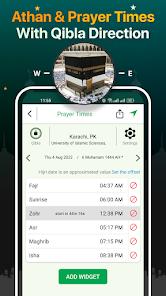
Around the reader sits the dashboard proper: global prayer schedules with countdowns, an offline Qibla compass, a Zakat tracker that calculates annual obligations from personal assets and savings, a masjid and halal-food locator, and a notification system that feedback describes as gentle reminders to read, alongside reflections and supplications. Consolidation is the pitch, and the warmest feedback cites the combination rather than any one tool — especially for travel and fasting seasons.
Two honest limits. We describe the prayer schedules and the compass as features; we don’t vouch for their accuracy, and won’t tell you whether to rely on them for observance — that’s your judgment, not ours. And one neutral, hardware-level note: the FAQ says the Qibla finder works offline via the device’s built-in sensors and GPS, and any sensor-based compass is bounded by the handset’s magnetometer and how recently it was calibrated. That is a property of the phone as much as the app.
Offline is a real feature here, with one asterisk
Offline support is more than a checkbox: the core text, translations, and several reference features work with no connection, and the compass is built to work offline. That’s a genuine differentiator: a plane or a dead-zone commute doesn’t take the app’s main function away.
The asterisk: offline audio downloads are a Premium unlock. Text offline is free, audio offline is not, which moves the paid tier from optional to close to necessary for an audio-led routine.
The monetization reality, stated plainly
The free tier is ad-supported, and the documented complaint is specific: ads can be frequent, and occasionally poorly targeted. We can’t tell you what any individual ad load will look like — that varies by region and network fill — but frequency and targeting quality are the two threads that recur in feedback. If interruptions during a reading session would bother you, treat the upgrade as part of the app’s real price rather than an optional extra.
On Premium, the developer’s FAQ states the upgrade comes via in-app purchases “which can range up to $99.99 for a full multi-device license pack.” Read that precisely: it’s the ceiling for the largest multi-device bundle, not an entry price. The listing describes no base tier and no subscription structure, so check live in-app pricing on your own store page. The upgrade removes ads and unlocks offline audio downloads, premium reciters, and translations.
Three specific bugs worth knowing about
The athan volume issue first, because it carries the most consequence. Documented feedback reports that athan alerts can override system volume settings and fire at maximum volume even on a silent profile. The stakes are real: an alert that ignores silent mode can go off in a meeting, in a hospital, or in the middle of the night. The feature is doing what it should — the problem is narrowly the volume-override behavior, and it’s the fix we’d most want prioritized.
Second, the prayer-time home-screen widget: reported issues include lag, countdowns rendering as negative numbers, and alarms failing to trigger on time. A negative countdown is a plain correctness bug, and a widget that misses its alarm undercuts the reason it’s on the home screen.
Third, exported bookmark files can fail to import correctly when migrating to a different device format — if you’ve built up bookmarks over years, verify an export actually restores before treating it as a backup. None of the three looks structural, but all are worth knowing.
How it compares
Two shapes exist here. Dedicated readers do one job — text, translation, search, typography — with a lighter footprint and fewer parts to break. All-in-one dashboards like Quran Majeed put reading, audio, scheduling, and location tools in one install. The trade: you stop juggling apps and gain tooling like the Hifz engine, at the cost of more surface area, more notifications and permissions, and more places for something to misbehave. If reading and study is your whole need, a focused reader is the better fit.
Recency and reputation
The app is actively maintained: Play lists an April 3, 2026 update, and the FAQ describes the Zakat Tracker as a recent addition — development is still adding function, not coasting. Store signals are strong — 10M+ installs, a 4.7 average across roughly 1.04 million ratings, eight screenshots, developer Pakdata. One figure needs a caveat: the description says the app is “used by over 100 million Muslims globally,” which sits oddly against Play’s own 10M+ install count. We treat that as the developer’s marketing claim, not a verified figure, and cite Play’s number.
Who it’s not for
This is the wrong app if you want a lean, single-purpose reader: the dashboard brings a notification, permission, and settings surface a plain reader doesn’t. It’s also a mismatch if your ad tolerance is low and you don’t intend to pay, since offline audio sits behind the paid tier. It’s a poor fit if you keep your phone strictly silent in meetings, clinical work, or overnight and would want athan alerts on, at least until the volume-override behavior is fixed. On an older handset, weigh the widget lag reports and the compass’s sensor dependence.
Our take
Quran Majeed earns a 4.3 from us, a shade under its 4.7, and the gap is deliberate rather than punitive. The ambition pays off: three script options, a translation and classical-tafsir layer, real offline text access, a well-judged set of daily utilities, and above all a memorization engine more thought-through than the category norm. What we hold back is for the ad-supported free tier, a Premium structure whose only published number is a $99.99 multi-device ceiling with no entry price stated, and three concrete defects — the athan volume-override being the one most likely to catch someone out at the wrong moment. If you want the whole workflow in one place, and especially if you’re doing memorization work, this is an easy recommendation.
How We Evaluate
We did not conduct hands-on device testing of this app. This review is grounded in Quran Majeed's Google Play listing and store description, its stated feature set (the three scripts, the translation and classical-tafsir layer, the Hifz audio engine with looping, speed control, interval pauses and voice recording, custom playlists, global prayer schedules, the offline Qibla compass, the Zakat tracker, and the masjid/halal locator), the documented pros and cons in our own database, the developer's published FAQ, the recurring themes in published user feedback, and the app's store signals: a 4.7 rating across 1,038,702 ratings, 10M+ installs, eight screenshots, an April 3, 2026 Play update, and its standing as a long-running title from developer Pakdata. We are reviewing the software — its features, reliability, usability, and value — and not the scripture. We are not in a position to verify scriptural or theological accuracy, nor the developer's scholar-certification claim; where the listing makes assertions of that kind we report them as the developer's stated position and leave verification to readers for whom it matters. Where we cite user sentiment, we are reflecting documented recurring feedback rather than personal sessions.
Pros & Cons
Scholar-Proofread Scripts: Offers authentic Uthmanic, Mushaf, and Indo-Pak scripts certified by an Alim.
Advanced Memorization Tools: Includes highly customizable audio loops, variable interval pauses, and voice recording features for Hifz study.
Unified Lifestyle Utilities: Integrates a precise Qibla finder, global prayer schedules, and a local Halal/Masjid locator.
High-Definition Audio Integration: Features clear recitations synchronized with on-screen scripture highlighting.
Custom Quran Playlists: Allows users to compile specific verses or chapters into custom audio playlists.
Reliable Offline Access: The core Quranic text, translations, and several reference features are fully functional without an internet connection.
- ✕
Intrusive Free Tier Ads: The ad-supported version can display frequent and occasionally poorly targeted advertisements.
- ✕
Periodic Notification Volume Issues: Athan alerts can occasionally override system volume settings, firing at maximum volume even on silent profiles.
- ✕
Countdown Widget Lag: The home screen widget for prayer times can occasionally lag, showing negative numbers or failing to trigger alarms on time.
- ✕
Bookmark Export Limitations: Exported bookmark files can sometimes fail to import correctly when migrating data to a different device format.
Download


FAQs
Are the script formats in Quran Majeed historically accurate?
Yes, all three script options (Uthmanic, Mushaf, and Indo-Pak) have been proofread and certified by a recognized Muslim Islamic scholar (Alim) to guarantee absolute textual accuracy.
How do the app's Hifz (memorization) tools assist students?
The app features a specialized audio engine that allows users to loop verses, adjust recitation speed, set interval pauses to repeat verses aloud, and record their voice to check pronunciation.
Does the Qibla compass require an active internet connection?
No, the Qibla compass utilizes the device's built-in sensors and GPS to locate the direction of Mecca, allowing it to function reliably offline.
What is the Zakat Tracker featured in the recent update?
The Zakat Tracker helps users calculate their annual Zakat obligations based on personal assets and savings, supporting charitable giving.
What does the Premium version cost, and what does it unlock?
The Premium upgrade is available via in-app purchases, which can range up to $99.99 for a full multi-device license pack. It completely removes ads, unlocks offline audio downloads, and grants full access to premium reciters and translations.
Hot Reviews
Users value the app for its accurate prayer countdowns, beautiful audio recitations, and offline Qibla compass, noting that it is particularly useful during travel and fasting seasons.
Students of Hifz find the app's advanced looping, repetition settings, and adjustable speeds highly effective for reviewing and memorizing chapters on the go.
English-speaking users from non-Arabic backgrounds appreciate the app's clear translations, easy-to-read scripts, and intuitive search features, which make scripture study highly approachable.
Users appreciate the daily notification system, which offers gentle reminders to read, alongside supportive reflections and supplications.