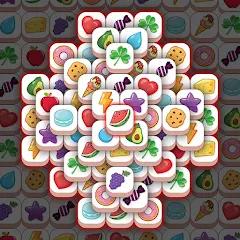
Tile Match - Puzzle Club


Overview
The core interaction loop relies on a simple selection tray at the bottom of the interface, which has a maximum capacity of seven tiles. Tapping an exposed tile on the main field transfers it to the tray. When three tiles with identical graphical assets are collected in the tray, they clear. If the player fills all seven slots without forming a match, the game enters a lock state, resulting in a failed attempt.
This interaction model exercises both visual scanning and working memory. Players must evaluate not only immediate matches, but also the order in which clearing top tiles will reveal the layers below. The game balances this mental effort by omitting a countdown timer in its standard modes, allowing players to plan moves at their own pace.
To support long-term retention across its massive library of over 50,000 levels, the game gradually increases board difficulty. This scaling is achieved through:
- Increasing the number of unique tile symbols on the board.
- Adding more complex overlapping layers.
- Restricting the number of instantly clearable pairs at the start of a level.
The developer, CodeRider, utilizes a unified codebase shared with other puzzle titles in its catalog. This shared architecture ensures stable offline play, keeping asset-loading times low and device resource usage minimal. However, the game relies heavily on full-screen interstitial ads between levels to support its free-to-play model, which can disrupt the overall experience.
Pros & Cons
Extensive Level Library: Offers over 50,000 unique levels, providing a long progression curve for casual players.
Stable Offline Support: Core gameplay runs locally without requiring a network connection, saving device battery and data.
Low Onboarding Friction: The single-tap mechanic is highly intuitive, making the game accessible to all player demographics.
Relaxing Visual Design: A wide variety of tile themes, including fruits, animals, and candies, keeps the interface visually fresh.
Pressure-Free Gameplay: The lack of level timers allows players to focus on strategic planning without time-based stress.
- ✕
Repetitive Progression: The core gameplay loop remains highly consistent across thousands of levels, which can lead to player fatigue.
- ✕
High Ad Density: Interstitial ads frequently trigger between levels, disrupting the game's relaxed pacing.
- ✕
Minimal Narrative Elements: Lacks story-driven or meta-progression systems, relying entirely on mechanical gameplay to retain users.
- ✕
Late-Stage Difficulty Spikes: Advanced level layouts often require using booster items, pushing players toward in-game currency purchases.
Download
 Get it on Google Play
  Get it on App Store
 FAQs
What causes a game-over state in Tile Match - Puzzle Club?
A level is failed when the active selection tray fills with seven tiles without forming a matching set of three.
Are there timed elements in standard levels?
No, standard levels do not have countdown timers, allowing players to plan their moves without time pressure.
How do booster items assist in clearing difficult boards?
Players can use boosters to undo their last move, shuffle the remaining tiles, or clear items from the tray.
Can I play the game without an internet connection?
Yes, the application is fully functional offline, as all essential visual and code assets are stored locally on the device.
How do I contact the developer for technical support?
For support or feedback, players can contact the developer, CodeRider, at Krishgodhani2@gmail.com.
Hot Reviews
The matching physics are clean and responsive. It is an excellent game for quick, low-stress play sessions where you can just zone out.
The puzzles are well-designed, but the frequency of interstitial ads after every level makes it hard to maintain a relaxing play rhythm.
Early levels offer a great casual experience, but later stages feature dense layouts that seem designed to force you into using paid booster items.