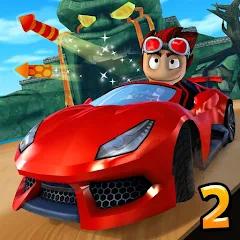
Beach Buggy Racing 2
The best idea here is the one that happens before the countdown: our source material records a powerup deck-building layer in front of every race, and both our own pros list and the recurring themes in published feedback put that deck alongside the driving physics at the top. The caveat is documented just as plainly and it sits on the economy — our cons list records upgrading cards and unlocking top-tier vehicles as requiring a significant amount of in-game currency, with progress feeling slow for free-to-play players.
- Players who want a layer of planning around the racing — our source material records a powerup deck-building system with over 45 collectable cards assembled into a custom deck before a race, and the feedback themes we hold celebrate exactly that tailoring of tactical options track by track
- Anyone who cares how a vehicle feels under them — our database's pros credit the physics engine with vehicle handling, weight distribution and drift dynamics, and the feedback themes single out body roll, drifting traction and off-road tire slip as immensely satisfying
- Players with a controller in the drawer — our FAQ records native support for USB and Bluetooth gamepads alongside touch steering and tilt, and our pros list records switching between them as seamless
- Collectors and customizers — our records describe a garage of over 55 vehicles, metallic, matte and rainbow paint jobs with decal sheets, and drivers who each carry one active ability usable once per race
- Players who won't spend and still want to be competitive quickly — the feedback themes we hold record upgrading cards to competitive levels as becoming painfully slow without spending real money, and our cons list records the same currency pressure on top-tier vehicles
- Anyone who wants the result decided purely by their own driving — our cons list records opponent AI sometimes using aggressive rubber-banding, with computer racers catching up regardless of player speed
- Players who want an uncluttered flow between races — our cons list records post-race advertisements cluttering the interface and disrupting navigation between menus
- Players who want the racing without a collection layer — our source material puts a deck built from over 45 powerup cards in front of every race, and our FAQ records those cards being upgraded with duplicates and gold coins, so the metagame is not optional


Overview
The interesting decision in Beach Buggy Racing 2 happens before the countdown rather than during it. Our source material describes a deck-building layer in front of every race: you assemble a hand of powerup cards, and that hand decides what you can pick up once you are moving. That choice, alongside the driving model, is what our own pros list and the recurring themes in published feedback both reach for first. The friction is documented just as clearly and sits on the economy: our cons list records that upgrading those cards and unlocking top-tier vehicles takes a significant amount of in-game currency, and that progress feels slow for free-to-play players. A 4.5 average across 809,031 ratings on 100M+ installs shows how that balance has landed for a very large audience; whether it lands for you depends on how you feel about the second half.
The deck is the actual pitch
Our source material calls the powerup deck-building system the game’s standout mechanic, a strategic card-game layer added to kart racing. Rather than collecting generic items, players collect and upgrade over 45 distinct powerup cards — the three our records name are Chain Lightning, Donut Tires and Killer Bees — and assemble a custom deck before a race, tailoring it toward aggressive attacks, speed boosts or defensive shields. Our FAQ describes the same loop from the player’s side: the deck you build from your unlocked cards is what determines which items you can collect from item boxes during the race.
We have not played this, so we cannot say how much a well-built deck swings a result — only that what our records describe moves part of the thinking off the track and into a menu. Our pros list credits the mechanic with letting players match a loadout to their own playstyle, and the feedback themes record that assembling decks for different tracks is highly celebrated.
The driving, which is what people mention first
Our source material and our FAQ both attribute the handling to Vector Unit’s proprietary Vector Engine combined with NVIDIA’s PhysX simulation technology, covering detailed off-road powerslides and active suspension systems. Our pros list is warmer, crediting the engine with vehicle handling, weight distribution and satisfying drift dynamics, and the feedback themes are the most specific of the three: players describe realistic body roll, drifting traction and off-road tire slip as making the driving feel immensely satisfying.
One recorded detail links the two halves of the game: our source material has each vehicle behaving differently depending on the surface — loose sand, slick mud, hot asphalt. If that holds in play, car and track become a second set of decisions stacked on the deck you already picked. We flag it as a claim on record rather than something we verified, as we do our source material’s description of the game as console-quality, which is our own database’s wording and not a finding of ours.
The garage, the drivers, the paint
Our records describe a garage of over 55 vehicles spanning beach buggies, monster trucks, muscle cars and formula supercars, and our pros list calls that roster a genuine strength, singling out detailed visual upgrades. Customization on record runs to metallic, matte and rainbow paint jobs plus decal sheets.
The drivers are more interesting mechanically. Our source material records customizable drivers who each carry one unique active ability — teleportation and confusion spells are the examples given — usable once per race to shift momentum, and our pros list calls this hero-style strategy in close races. Our FAQ names four drivers new to this sequel: Mikka, Beat Bot, Commander Nova and Clutch, joining a returning cast whose size our records do not give.
Where you race, and in what
The environments our source material lists are Egyptian pyramids, pirate shipwrecks and alien research labs, filled with destructible elements and hidden shortcuts. On modes, our records give real-time six-driver online lobbies, daily drift challenges, obstacle courses, one-versus-one boss races and weekly tournaments, and our pros list credits that spread — daily drift trials and weekly tournaments in particular — with keeping the game from going stale.
Controls are a documented strength: our FAQ records native support for USB and Bluetooth gamepads alongside touch and tilt, and our pros list adds that switching between them is seamless. For a physics-led racer, a real stick as an option is not a small thing.
The economy, stated plainly
This is the part to settle before installing, and our records are specific. Two distinct costs are documented. The first is currency: our cons list records that upgrading powerup cards and unlocking top-tier vehicles requires a significant amount of in-game currency, making progress feel slow for free-to-play players. The second is direct purchase: our cons list records that microtransactions for premium cars can be quite expensive, sometimes exceeding seven dollars per vehicle. That is the only price figure our records hold, and it is a recorded figure rather than a price we went and checked. We quote no other, put no conversion or regional reading on it, and do not describe what a purchase includes beyond what is written down.
Our FAQ fills in how card upgrades work: powerups are improved by collecting duplicates from reward chests and spending gold coins, raising attributes such as damage or duration. How those chests are obtained, and how their contents are determined, is not something our records describe, and we are not going to fill that gap with assumptions.
The feedback themes sharpen the same point: many reviewers criticize the economic structure, saying that upgrading cards to competitive levels becomes painfully slow without spending real money. The word doing the work is competitive — the complaint attaches to the level needed to compete rather than to progress in general, which matters given the online lobbies and weekly tournaments also on record.
What our records support is a plain caveat rather than a reading of anyone’s intent: free-to-play progress on cards and top vehicles is recorded as slow, and enough players say so for it to be one of the three recurring themes we hold. Whether that pace reads as patience or as a wall is the judgement this game asks you to make before installing.
Advertising and the AI, at the recorded scope
Our cons list records post-race advertisements cluttering the interface and disrupting navigation between menus. The scope is worth reading precisely: what is documented is advertising after a race and around the menus, not interruptions during one. We will not inflate it — though on a game whose loop returns you to a deck screen between races, menu friction lands somewhere you visit often.
The other recorded flaw is opponent behaviour: our cons list records that AI racers can sometimes rely on aggressive rubber-banding, catching up unnaturally regardless of player speed. Note sometimes, the word our records use. There is a tension worth naming: the same records sell the game on deck-building and precise physics, and a rubber-band that closes a gap you earned reduces the payoff on both. That reading is ours.
What our data does not settle
Two things sit outside what we hold. Our dump carries no Play listing update date, so we say nothing about when the listing was last refreshed. And our records carry no information on crashes, frame-rate behaviour, install size or device requirements. That is where our material stops: install size and device compatibility are published on the live Play listing, which is the place to check them.
Who it’s not for
This is not the game for a player who wants to be competitive online quickly without spending: the recorded complaint is precisely that card upgrades to competitive levels are slow without money. It is not for players who want every result to trace back to their own driving, given the recorded rubber-banding, nor for anyone wanting an uninterrupted flow between races, since post-race advertising and menu clutter are documented. And it is not for a player who wants pure racing with no collection layer, since the card deck, the duplicates and the gold coins all sit between you and a fully upgraded loadout.
Our take
What our records describe is a kart racer with one genuinely distinctive idea and a well-liked driving model underneath it, sold at a cost our own records set out in plain terms. The deck-building, the physics, the 55-plus garage, the driver abilities and the gamepad support read as documented substance rather than listing padding, and a 4.5 average across 809,031 ratings is not an accident.
We land a little under the store average at 4.3, and the gap is the four things our own cons list documents rather than any doubt about the racing: the in-game currency needed for card upgrades and top-tier vehicles, premium cars at the price our records carry, opponent AI that can rubber-band, and post-race advertising in the menus. Six documented strengths against four documented flaws is a good ratio, and the flaws cluster in one place rather than touching the driving.
If you are content to progress at the recorded pace, most of that friction stays in the background. If you want a competitive card level on a free account quickly, our records suggest that is the harder path — and that distinction, more than any score, is what should decide it.
How We Evaluate
We did not hands-on test Beach Buggy Racing 2. This assessment rests on the Google Play listing signals we hold, the store description on record, the pros and cons kept in our own editorial database, our FAQ entries, and the recurring themes in the user feedback our database records — which we summarise rather than quote. The star labels stored beside those feedback entries do not track their content: all three we hold carry five-star labels, yet one is entirely critical of the game's economy. We therefore weighed what each entry says and set the scores aside, and we cite no star rating alongside any feedback theme below. We also weighed the store signals: a 4.5 average across 809,031 ratings, 100M+ installs, seven screenshots, and a Racing category listing from Vector Unit. Our dump carries no Play listing update date, so we make no claim about when the listing was last refreshed. We hold exactly one price figure — the one our cons list records for premium cars — and it is a figure on record rather than a price we checked ourselves. We quote no other, invent none, put no conversion or country-specific reading on it, and do not describe what any purchase includes beyond what is written down. Where our records describe how something feels to drive, we report it as someone else's account and attribute it. We hold no content or age-rating data for this title, so we make no suitability call beyond audience fit.
Pros & Cons
Uses a highly realistic physics engine, delivering fantastic vehicle handling, weight distribution, and satisfying drift dynamics.
The innovative card-deck mechanics allow players to customize their powerup loadouts to match their personal playstyle.
Features a massive garage of over 55 unique, customizable vehicles with highly detailed visual upgrades.
Driver-specific special abilities add a fun layer of hero-style strategy to tight races.
A great selection of gameplay modes, including daily drift trials and weekly online tournaments, keeps the experience fresh.
Extensive control support allows players to seamlessly switch between touch steering, tilt, and Bluetooth gamepads.
- ✕
Upgrading powerup cards and unlocking top-tier vehicles requires a significant amount of in-game currency, making progress feel slow for free-to-play players.
- ✕
Direct microtransactions for premium cars can be quite expensive, sometimes exceeding seven dollars per vehicle.
- ✕
Opponent AI can sometimes rely on aggressive "rubber-banding" mechanics, where computer racers catch up unnaturally regardless of player speed.
- ✕
Post-race ads can clutter the user interface and disrupt navigation between menus
Download
 Get it on Google Play
  Get it on App Store
 FAQs
What physics engine powers the vehicle handling in Beach Buggy Racing 2?
The game is built on Vector Unit's proprietary Vector Engine and uses NVIDIA’s PhysX technology to deliver realistic off-road suspension and drift physics.
How do I upgrade my powerup cards?
Powerups are upgraded by collecting duplicates from reward chests and spending gold coins to improve their attributes, such as damage or duration.
Can I play this game with an external controller?
Yes. The application features native support for USB and Bluetooth gamepad controllers, alongside standard touch and tilt options.
What are the newly added characters in this sequel?
Four new drivers—Mikka, Beat Bot, Commander Nova, and Clutch—join the returning cast, each bringing their own unique special ability to races.
How does the powerup deck-building system work?
Players build a custom deck from their unlocked powerup cards before a match, determining which items they can collect from item boxes during the race.
Hot Reviews
Players consistently praise the physics engine, noting that the realistic body roll, drifting traction, and off-road tire slip make driving feel immensely satisfying.
Many reviewers criticize the game’s economic structure, stating that upgrading cards to competitive levels becomes painfully slow without spending real money.
The strategy of assembling custom powerup decks is highly celebrated, with players enjoying the ability to customize their tactical options for different tracks.