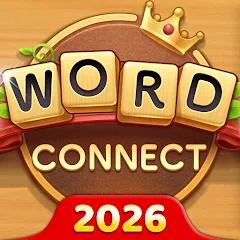
Word Connect
Volume and calm, executed well: a swipe-to-connect letter circle feeding a crossword grid, over 20,000 levels, three modes, offline play and a 4.8 average across more than a million ratings. The trade-off is a heavy free-tier ad load — and both our source material and our own database record promotional bundle pop-ups continuing to appear even after the ad-removal purchase, which is the expectation to check before you spend.
- Players who want a bottomless casual word puzzle with no clock and no downside to guessing — over 20,000 levels, and our FAQ records no time limits, score deductions or penalties for an incorrect swipe, so a board can sit half-finished indefinitely
- Commuters and frequent flyers: our database records a local game engine that runs levels and daily challenges without an active connection, and many players appreciate that offline functionality for flights, commutes and areas with poor cellular service
- Anyone who likes checking a word the moment they solve it — tapping a completed word in the grid opens a pop-up with its definition, which our source material records as backed by integration with Oxford Dictionaries
- Free players with low tolerance for interruption — our source material records frequent full-screen interstitial and video ads between levels, and players report that the game's high ad density makes a peaceful puzzle session difficult to sustain
- Buyers expecting an ad-removal upgrade to end every prompt — both our source material and our own database record that promotional pop-ups for in-game bundles continue to appear after that purchase
- Confident word-game players who want a stiff challenge from the opening levels; our database records early tiers relying on basic three-letter and four-letter combinations, and our FAQ records no time limits to supply pressure instead


Overview
The case this one makes
Word Connect’s pitch isn’t novelty, and we think that’s exactly why it has held up. What’s on record is volume, pacing and an absence of pressure rather than a new mechanic — and the response is hard to argue with: 4.8 across 1,176,569 ratings on 50M+ installs is about as strong a rating signal as this category produces. We take that at full weight; the criticisms below sit alongside it, not on top of it. What follows isn’t a play session.
Swipe, connect, fill the grid
The loop is a hybrid, and the join is the good part. Our source material describes a swipe-to-connect mechanic: players connect circular sets of letters to populate empty crossword grids, so a word drawn from the letter circle fills its slots in the grid. Anagram work and crossword deduction feed each other — the circle tells you what you have to work with, the grid tells you the shape you’re hunting for.
What shapes that loop most is a rule recorded in our FAQ: no penalty for an incorrect swipe — no score deduction, no time limit, nothing lost for a wrong guess. Because guessing is free, working through combinations is a legitimate strategy rather than a punished one, and a board can sit half-solved indefinitely. It also caps how demanding the game gets: the only pressure is vocabulary.
The definition lookup, precisely
The definition tool is worth describing accurately, because it’s easy to over-claim. What’s documented is specific and modest: after completing a word, tapping it in the crossword grid opens a pop-up showing its definition. That’s the whole mechanic — a definition on tap, without leaving the board.
Our source material records that the app integrates directly with Oxford Dictionaries, linking to an authoritative reference database to validate player inputs rather than a generic word bank, and our own database lists an “Integrated Oxford Dictionary Database” among its strengths. We report that as those records state it rather than as a finding of our own.
Three modes and the bonus chest
Progression splits across three modes — more structure than a swipe-a-word game strictly needs. Normal Mode is untimed word search and anagram play. Crossword Mode links intersecting letters as structural clues, so a hard word becomes tractable once its neighbours are down — a real difficulty valve, not a cosmetic variant. Daily Challenge runs calendar-locked puzzles awarding unique badges and bonus coins.
Alongside them sits Extra Words, the mechanic we’d single out: valid words found outside the main grid still count, filling a bonus chest that pays extra coins when full. It rewards looking harder at the letters than the puzzle requires, which keeps an easy board from being a waste of time.
Twenty thousand levels, and a curve that cuts both ways
Over 20,000 levels is what our source material calls a long progression path designed to keep players engaged over time; our database credits it with long-term engagement without content repetition. How many hours that converts to isn’t on record and we won’t guess — but this is not an app you finish. And 11 selectable themes change tile colours and background scenes — trivial until you think how long a 20,000-level path leaves you looking at the default.
The curve draws complaints from opposite directions, and naming both beats picking a side. Our database records early tiers relying on basic three-letter and four-letter combinations, which can feel too simple for experienced players. Some reviews point out that later levels often require highly obscure words or archaic terms, which can feel less intuitive and make hints necessary. Two audiences, two ends of one ramp — and the long middle is where this fits most people.
Offline play, and one unknown
Our database records a local game engine letting players complete levels and daily challenges without an active internet connection, and a feedback theme records many players appreciating that for flights, commutes and areas with poor cellular service. For a game whose habitat is dead time, that’s no checkbox feature.
It raises a question our material doesn’t answer. The monetization on record is ad-supported, and ads need a connection to be served, so something has to give when the game runs offline — and we cannot determine from what we hold what actually happens. We flag that as undetermined rather than guess; it’s worth checking against the current build if offline play is your reason for installing.
The ad load, stated plainly
Our source material records an aggressive, ad-heavy monetization structure behind the clean front end: free-to-play users encounter frequent full-screen interstitial and video ads between levels, plus promotional pop-ups for in-game bundles. Our database lists intrusive ad interruptions as a con, and players report that the game’s high ad density and frequent pop-ups for in-game purchases make it difficult to enjoy a peaceful puzzle session. The structural point: an untimed, penalty-free puzzle sells calm, and interruption cuts against that premise harder than it would in a fast-paced title.
The item a prospective buyer should read twice is more specific: both our source material and our own database record that promotional pop-ups for in-game bundles continue to appear even after players purchase ad-removal upgrades. The recorded scope is ads removed, bundle promotions still appearing. We hold no price for that upgrade and quote none — but if your reason for paying is an uninterrupted board, that is the expectation to verify against the current version before you spend.
What our database records on data sharing
This belongs in the open, not a footnote. Our own editorial database records that the app’s background data framework shares user telemetry, location data and device identifiers with third-party networks. We report that as our database’s finding and add nothing to it: we aren’t alleging misuse, we aren’t saying anything was sold or leaked, and we don’t know which networks are involved. Free, ad-supported games are generally built on data flows of this kind, which makes this the category norm rather than an outlier — a reason to know about it, not a reason to wave it through. If it matters to you, check your device’s permission settings and the listing’s Data safety section, which reflect today’s build rather than our snapshot.
Backup, and when it stutters
Two practical notes from our FAQ. Progress, coin balances and level history back up and sync across devices by linking the app to a Facebook account — the route on record, worth knowing before you commit a long level history to a phone you’ll replace. We hold nothing for or against linking, so we advise neither way. For lag or freezes, the recorded remedies are clearing the app’s cache in system settings, updating to the latest version, or contacting support at casual.support@zenjoy.net.
Two claims we are not making
Our source material describes the app as designed to train the brain and expand vocabulary, and says the definition lookup turns casual gaming into an educational activity. Our database separately credits the lookup with helping players learn new vocabulary. And reviews highlight the benefit of the integrated dictionary tool, noting that it helps players learn new words and verify definitions during gameplay. Three sources, kept separate: we have verified no learning or cognitive outcome and hold no research on record. What’s documented is a definition shown on tap.
Our source material also states that the wooden-block textures help reduce eye strain during long sessions. We record that as stated design intent only: not verified, no evidence held, not a basis on which we’d point anyone here.
Recency and category fit
The listing is being kept up: Google Play records an update dated April 3, 2026, alongside six screenshots and that 4.8 average over 1,176,569 ratings. In a crowd of near-identical swipe-a-word titles, the differentiators we’d name are the size of the level path, the three-mode split, Extra Words and offline play — against the category’s usual trade-off, reach funded by ad density.
Who it’s not for
If interruption is what spoils a puzzle and you won’t pay to remove ads, the free tier’s recorded ad density is the most consistent friction here. It’s a weak match for confident players who want stretching immediately — our database records opening tiers leaning on three- and four-letter combinations, with no time limits on record to supply pressure instead. And if you’re buying ad removal to reach a prompt-free experience, check that against the current build: bundle pop-ups are recorded as continuing past that purchase.
Our take
Recommended, and the 4.3 we land on sits a small step below a very strong 4.8 rather than arguing against it. The core is good on the record: a letter circle feeding a crossword grid, no time limits and no penalty for a wrong guess, over 20,000 levels, three modes, an Extra Words chest, 11 themes, offline play and a definition pop-up on any solved word. We hold back a few tenths for four things: an ad load players report as spoiling a peaceful session, promotional prompts our records say persist after the ad-removal purchase, a curve that reads too easy early and leans on obscure terms late, and the telemetry, location and device-ID sharing our own database notes. For most people wanting a large, calm, offline-capable word puzzle, this is one of the better-built options in the category.
How We Evaluate
We did not conduct hands-on device testing of this game, so nothing here is a play report. This review rests on the app's Google Play listing and the description on record, its stated feature set (swipe-to-connect circular letter sets feeding crossword-style grids, over 20,000 levels, the tap-a-word definition lookup, Normal / Crossword / Daily Challenge modes, the Extra Words bonus chest, 11 selectable themes and offline play), the pros and cons recorded in our own editorial database, our FAQ, recurring themes in published user feedback read as sentiment summaries written by our team rather than verbatim quotes, and the store signals: a 4.8 average across 1,176,569 ratings, 50M+ installs, six screenshots, a Play update dated Apr 3, 2026, and developer ZenLife Games Ltd. Three framing notes. The Oxford Dictionaries integration is recorded in our source material and in our own editorial database, and we report it as those records state it rather than as a finding of our own. We have verified no learning, cognitive or eye-strain benefit and hold no research on record for any of them, so we attribute those claims to their sources rather than asserting them. And we hold no pricing data for the in-app purchases or the ad-removal upgrade, so we quote no prices.
Pros & Cons
Integrated Oxford Dictionary Database: The built-in lookup tool provides definitions for completed words, which helps players learn new vocabulary.
Vast Progression Path: Over 20,000 levels ensure long-term engagement without content repetition.
Offline Access Support: The local game engine lets players complete levels and daily challenges without an active internet connection.
Diverse Play Modes: Features normal anagram boards, crossword layouts, and unique daily challenges.
Custom Visual Customization: Includes 11 selectable themes to personalize tile colors and background scenes.
Rewarding "Extra Words" Mechanic: Finding words outside the main puzzle grid awards bonus coins, encouraging players to explore more complex anagrams.
- ✕
Intrusive Ad Interruptions: Frequent interstitial ads and pop-up promotional offers can disrupt the casual flow of gameplay.
- ✕
Persistent Purchase Prompts: Pop-up offers to buy extra coins and items continue to appear even after purchasing ad-free upgrades.
- ✕
Repetitive Early Gameplay: Early level tiers rely on basic three-letter and four-letter combinations, which can feel too simple for experienced players.
- ✕
Broad Data Telemetry Sharing: The background data framework shares user telemetry, location data, and device IDs with third-party networks.
Download

FAQs
How do players access word definitions in Word Connect?
After completing a word on the board, players can tap the word in the crossword grid to open a pop-up window showing its definition.
Can progress be restored when changing devices?
Yes, players can back up and sync their progress, coin balances, and level history across devices by linking the app to a Facebook account.
What are "Extra Words" and how do they benefit players?
Extra words are valid terms that are not part of the main crossword grid. Finding them fills a bonus chest that awards extra coins when full.
Is there a penalty for making incorrect word swipes?
No, there are no penalties, score deductions, or time limits, allowing players to guess different combinations at their own pace.
How can a player resolve performance lag or freeze issues?
Clearing the app's cache in the system settings, updating to the latest version, or contacting support at casual.support@zenjoy.net can resolve performance issues.
Hot Reviews
Players report that the game's high ad density and frequent pop-ups for in-game purchases make it difficult to enjoy a peaceful puzzle session.
Reviews highlight the benefit of the integrated dictionary tool, noting that it helps players learn new words and verify definitions during gameplay.
Many players appreciate the game's offline functionality, which allows them to play levels during flights, commutes, or in areas with poor cellular service.
Some reviews point out that later levels often require highly obscure words or archaic terms, which can feel less intuitive and make hints necessary.